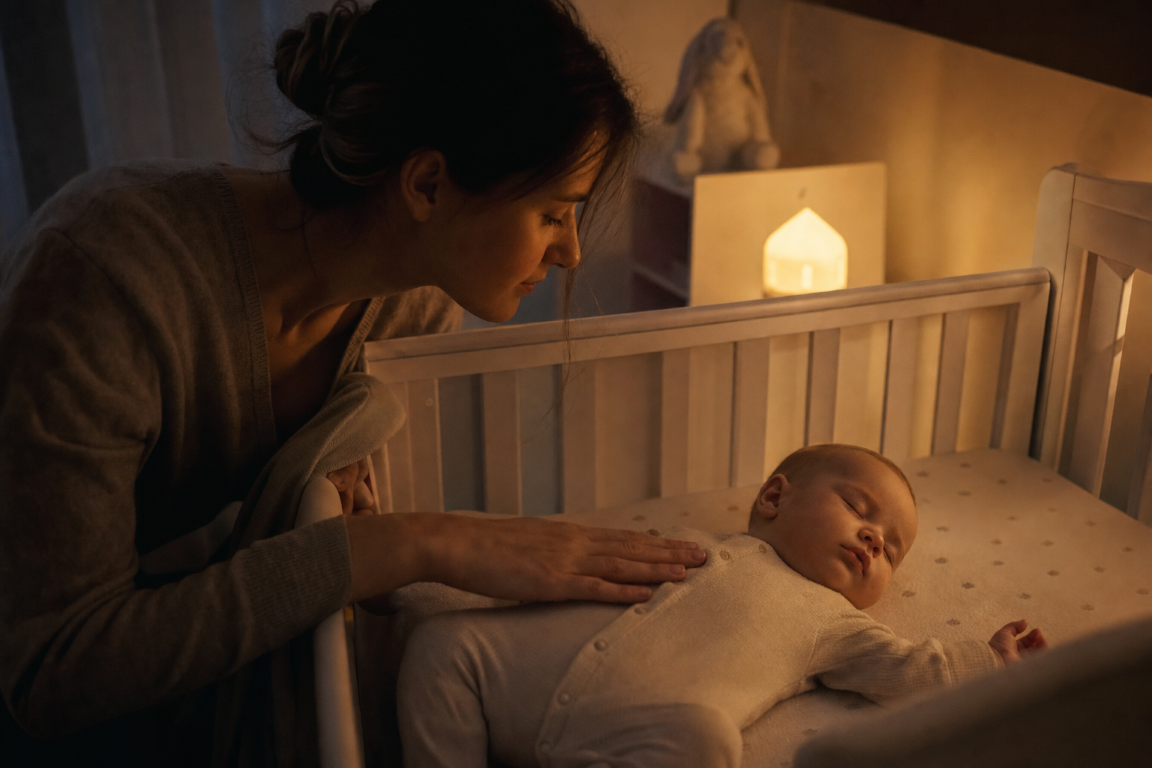
In short: Night awakenings in children under 2-3 years old are a physiological norm. The baby's brain goes through short sleep cycles, and in between, the baby partially wakes up. The key role is played by whether he is able to fall asleep again on his own.
How a child's sleep works
Human sleep consists of cycles: the light sleep phase alternates with the deep sleep phase and the REM (rapid eye movements) phase. In adults, one cycle lasts about 90 minutes; in newborns - only 40-50 minutes, in children under one year old - about 60 minutes. At the end of each cycle, the brain "floats" into a state of partial wakefulness for a few seconds. At this moment, the adult does not even notice the awakening and falls asleep again; A child who cannot fall asleep on his own begins to cry, demanding the same conditions under which he fell asleep initially.
That is why a child who is laid down with the breast or in his arms wakes up at night and demands the same. This is not whims - this is the work of the nervous system. Understanding this mechanism helps parents to perceive the situation more calmly and choose a strategy.
Physiological causes of awakenings
Hunger
Newborns have a small stomach, breast milk is absorbed quickly - in 1.5-2 hours. That is why night feedings in a newborn are a normal and necessary part of life in the first months. Gradually, as complementary foods are introduced and the volume of the stomach increases, the need for night feedings decreases on its own. In most healthy babies, this happens between 6 and 12 months, although many babies continue to ask for a breast or bottle at night and after a year – this is also a variant of the norm.
Teething
Discomfort in the gums during teething often disrupts sleep. The child may wake up several times a night, be capricious, pull his hands into his mouth. As a rule, this lasts 2-5 days for each tooth and then goes away on its own. If sleep is severely disturbed and the child looks clearly suffering, it is worth consulting a pediatrician.
Developmental Spurts and Sleep Regression
At about 4, 8, 12, 18 months and about 2 years of age, children experience periods of intense neurological development. At this time, the brain is rebuilt, sleep temporarily becomes more sensitive. Such periods are called sleep regressions: a child who previously slept well suddenly begins to wake up often. This usually lasts 2-6 weeks and goes away on its own.
Illness and malaise
With a runny nose, otitis, colic or other ailments, the child sleeps restlessly. If awakenings began suddenly against the background of good previous sleep, it is worth checking if the baby is sick.
Behavioral and psychological causes
Associations with sleep
Associations with sleep are the conditions under which the child is used to falling asleep: breasts, rocking, pacifiers, the presence of a parent nearby. If the baby falls asleep only in the presence of these conditions, he will demand them every time he wakes up between cycles. This is the most common cause of frequent night awakenings in children over 4-6 months. Gradual learning to fall asleep on your own helps to break this cycle.
Overexcitement before bed
Active games, bright lights, screens, and noise 1-2 hours before bedtime increase the level of cortisol, a stress hormone. The child falls asleep more difficult and sleeps more restlessly. The ritual of going to bed — quiet games, bathing, reading — helps the nervous system calm down and prepare for sleep.
Sleep disorders
When a child is overtired or, conversely, not tired enough by the time of a night's sleep, it is more difficult to fall asleep, and sleep becomes more fragmented. Too late or too early evening sleep, insufficient daytime sleep - all this affects the quality of night sleep. It is important to focus on the norms of sleep by age and signs of fatigue of the child himself.
Separation anxiety
After 6-8 months, most children begin to understand that their mother may leave and not return immediately. Separation anxiety is a normal stage of a child's development. During this period, the baby may begin to wake up more often at night, looking for his mother. This will pass with age; The main thing is to react calmly and consistently.
Sleep conditions
The quality of sleep directly depends on where and how the child sleeps. Let's look at the key factors.
- Temperature: the optimal temperature in the children's room is 18-22 ° C. Overheating disturbs sleep more than light coolness.
- Noise: Quiet monotonous white noise helps the baby not to react to household sounds and sleep longer.
- Light: Darkness stimulates the production of melatonin. Blackout curtains or blinds help not only at night, but also during daytime sleep.
- Place to sleep: A stable place to sleep helps the baby to form the "crib = sleep" association.
Read more about the optimal conditions for a child's sleep — temperature, humidity, light — in a separate article.
What helps to improve sleep
There is no one-size-fits-all "recipe" for all children, but a few principles work in most cases.
- Ritual of going to bed. A constant sequence of actions before bed (bathing → pajamas → feeding → a book → a lullaby) signals to the brain: sleep is coming soon. The ritual should be the same every evening and take 20-40 minutes.
- Watch for signs of fatigue. Yawning, rubbing the eyes, and decreased activity are signs that the child is ready for sleep. Missing this "window" means getting an overexcited baby who finds it difficult to fall asleep.
- Work on associations with sleep. Gradually reduce the "help" when falling asleep. This does not necessarily mean using hard methods - there are soft methods of laying down without tears.
- Provide comfortable sleeping conditions. Check the temperature, lighting, clothes - sometimes it is enough to remove one irritant to improve sleep.
- Be consistent. A child's brain forms habits through repetition. Changes do not give results in a day, but in 2-4 weeks.
It is important to know: It is difficult to "endure" frequent awakenings, but the chaotic reactions of parents (sometimes they come quickly, sometimes they leave him crying for a long time) only confuse the child. Consistency is more important than rigor.
Co-sleeping: pros and cons
Some families choose co-sleeping as a way to cope with nighttime awakenings. This helps the mother not to get up to the baby and it is easier to breastfeed at night. However, co-sleeping has both benefits and safety risks — especially for babies under 6 months of age. If you practice or plan to sleep together, it is important to know the safety rules.
When awakening is not the norm
Most nocturnal awakenings in children are a variant of the norm. But sometimes, frequent or unusual awakenings can indicate medical causes.
When to see a doctor
- The baby wakes up with loud crying that is difficult to stop, and it repeats every night at the same time (night terrors)
- You notice pauses in breathing, snoring, noisy breathing during sleep – there may be signs of sleep apnea
- The child does not gain weight well against the background of frequent night awakenings
- Awakenings are accompanied by vomiting, high fever, rash
- After 6 months, the baby wakes up more than 5-6 times a night and this does not improve over time
- As a parent, you experience severe exhaustion, anxiety or depression due to sleep deprivation
Frequently Asked Questions
At what age can a child sleep through the night without waking up?
There is no single answer. Most babies start sleeping in long chunks (5 to 6 hours straight) between 4 and 6 months, but many continue to wake up once or twice a night until the end of the first year or longer. Sleep norms vary greatly from child to child. Check the current sleep norms by age.
Is it necessary to breastfeed every time the baby wakes up at night?
Not necessarily. In the first 3-4 months, feeding at each awakening is the norm. After 6 months, you can gradually try other ways to calm the baby: stroke, give a pacifier, just wait a few minutes - sometimes the baby falls asleep on his own. Read more about this in the article about night feedings in a newborn.
Will it help to add complementary foods before bedtime so that the child sleeps better?
Studies do not confirm that the introduction of solid foods before bed improves sleep. The link between satiety and nighttime sleep in infants is not as direct as it seems. The decision to start complementary foods should be made based on the child's readiness for complementary foods, and not on the hope of better sleep.
Conclusion
Frequent nighttime awakenings are one of the most common "problems" of the first years of life, and in most cases it is a normal part of childhood development. Understanding the biological causes helps not to panic. A consistent sleep ritual, comfortable conditions, and gradual learning to fall asleep on your own — these steps really improve the situation. Remember: this is temporary, and most children eventually sleep better without any "method."
Bibliography
- American Academy of Pediatrics. "Healthy Sleep Habits: How Many Hours Does Your Child Need?" HealthyChildren.org, 2022.
- Mindell, J.A., et al. "Behavioral Treatment of Bedtime Problems and Night Wakings in Infants and Young Children." Sleep, 2006; 29(10): 1263–1276.
- Owens, J.A. "Classification and Epidemiology of Childhood Sleep Disorders." Sleep Medicine Clinics, 2007; 2(3): 353–361.
- Galland, B.C., et al. "Normal Sleep Patterns in Infants and Children: A Systematic Review of Observational Studies." Sleep Medicine Reviews, 2012; 16(3): 213–222.
- Price, A.M.H., et al. "Five-Year Follow-up of Harms and Benefits of Behavioral Infant Sleep Intervention." Pediatrics, 2012; 130(4): 643–651.
- WHO. "Guidelines on Physical Activity, Sedentary Behaviour and Sleep for Children under 5 Years of Age." 2019.
- Zakharchenko V.I. et al. National Program for Optimizing Feeding Children of the First Year of Life in the Russian Federation. Moscow, 2019.
This material is for informational purposes only and does not constitute medical advice and is not a substitute for medical advice. If a child's sleep is accompanied by alarming symptoms, a pronounced deterioration in health, problems with breathing, feeding or weight gain, it is necessary to consult a qualified medical specialist as soon as possible, and not rely only on information from the Internet.