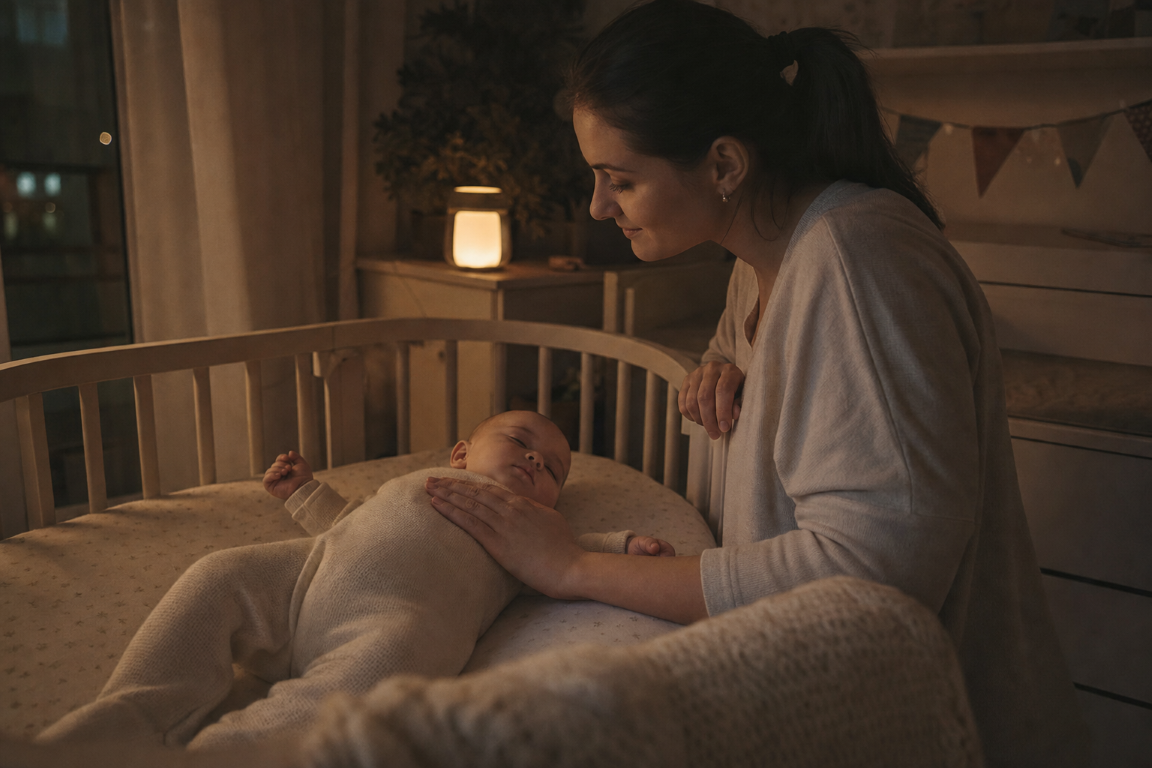
In short: Self-falling asleep is the ability of a child to fall asleep without external help (rocking, breasts, pacifiers). This skill can be gently formed starting from 4-6 months. It allows the child to move between sleep cycles at night without waking up.
What is self-falling asleep and why is it needed
All people, both adults and children, wake up between sleep cycles. The difference is that the adult falls asleep again without realizing it. A child who knows how to fall asleep on his own does the same: he wakes up between cycles, "finds" his usual state and falls asleep again without help.
A child who does not have this skill, every time he wakes up, requires the same conditions under which he fell asleep initially: breasts, rocking, the presence of his mother. This explains why the child often wakes up at night – not because he is hungry or sick, but because he does not know how to fall asleep on his own.
At what age to start
- Up to 4 months: not recommended. The nervous system is still immature, the needs of the child must be met immediately. Attempts to "teach" can cause unnecessary stress without result.
- 4-6 months: optimal start. The brain is already able to form new habits. It is at this age that the architecture of sleep changes (regression at 4 months) - a good moment for new associations.
- 6-12 months: also good, but the older the child, the stronger the established habits and the greater the resistance to change.
- After a year: Perhaps, but requires a more patient approach.
Associations with sleep: the core of the problem
Associations with sleep are the conditions under which a child is accustomed to falling asleep. They can be "positive" (the child requires the active participation of the parent: breasts, rocking, singing) and "neutral" (white noise, favorite toy, own crib).
The goal of learning to fall asleep is the transition from positive associations to neutral ones or the complete absence of external conditions. This does not mean "denying love to a child" – it means giving him a new tool.
Preparation for training
Before you start any method, make sure that:
- The child is healthy and does not go through an acute period (sleep regression, teething, illness)
- You have a consistent sleep ritual of at least 1-2 weeks
- You have agreed with your partner on a unified approach
- You are prepared for the inconsistency of the first 3-5 days and accept it
- Comfortable sleeping conditions are provided: darkness, temperature, silence or white noise
The "sleepy, but not sleeping" method
The most gentle first step is to try putting the baby in the crib when he is already sleepy, but not yet asleep. The bottom line: the last thing the child "sees" before falling asleep should be the crib, and not the parent's chest or hands.
How to do this gradually while breastfeeding:
- Start feeding a little earlier – not at the very end of the ritual, but in the middle of it.
- After feeding, continue the ritual: shake a little, read a book.
- Put in the crib in the state of "heavy eyelids, but open eyes".
- Stay close – hand on your stomach, quiet words.
- Gradually remove help.
Gradual Aid Reduction Method
If the baby falls asleep with rocking, gradually reduce the intensity: active rocking → slow rocking → slight rocking → just hold in your arms still → hold over the crib → in the crib with your hand on your stomach → the arm is removed.
Each step is a few days. Take your time. Progress from stage to stage is already a victory.
Nighttime Self-Sleep Training
An important rule: start with daytime dreams, not night dreams. At night, fatigue and anxiety are high for both - both the child and the parents. When daytime dreams get better, night dreams will follow on its own or require less effort.
For night awakenings after the skill begins to form, give the child 3-5 minutes before your arrival. Sometimes the baby falls asleep on his own. If not, come in, calm down with your voice or hand, but do not pick up and do not feed (if the decision to cancel night feedings has been made).
Important: self-falling asleep is a skill, not a personality trait. Some children master it in 3-5 days, others need 3-4 weeks. This does not mean that you are doing something wrong.
Typical mistakes
- Inconsistency. Today they let him rock, tomorrow he doesn't – the child does not understand the rules and intensifies the protest. Consistency is more important than rigidity.
- Start at the wrong time. Illness, regression, change of residence are bad times for learning.
- It's too late to put it to bed. An overtired child has a harder time falling asleep. Know the norms for age and lay in the "window".
- Expect instant results. Changing a habit takes a few weeks. Assess progress over a period of 2 to 3 weeks, not the next morning.
Self-falling asleep and gentle bedding methods
Self-falling asleep is the goal. Soft methods of styling are tools to achieve it. The chair method, fade-out, pick-up/put-down are all aimed at forming the same skill. Read more about the methods in the article on soft styling without tears.
When to see a doctor
- Despite 4-6 weeks of consistent work, there is no progress
- The child screams to the point of vomiting or clearly experiences severe stress at any attempt
- Sleep difficulties are combined with alarming signs in development
Frequently Asked Questions
Is it necessary to teach self-sleep?
No. If you are satisfied with the current situation, and the whole family gets enough sleep, there is no mandatory norm. Learning to fall asleep makes sense when the current way of falling asleep creates difficulties for the family.
Does crying in learning to fall asleep harm?
Several large studies (including AAP papers) have found no long-term negative effects of learning to sleep with moderate crying on a child's mental development. However, it is important to distinguish short-term protest crying from distress – and always respond to obvious signs of pain or fear.
Conclusion
Self-falling asleep is one of the most valuable gifts you can give to your child. Children with this skill sleep better, longer, wake up in a better mood – and let their parents get enough sleep. Start gently, be consistent, focus on the child – and the result will definitely come.
Bibliography
- Mindell J.A., et al. "Behavioral Treatment of Bedtime Problems and Night Wakings." Sleep, 2006.
- Price A.M.H., et al. "Five-Year Follow-up of Harms and Benefits of Behavioral Infant Sleep Intervention." Pediatrics, 2012; 130(4): 643–651.
- Gradisar M., et al. "Behavioral Interventions for Infant Sleep Problems: A Randomized Controlled Trial." Pediatrics, 2016; 137(6).
- Hiscock H., Wake M. "Randomised Controlled Trial of Behavioural Infant Sleep Intervention." BMJ, 2002.
- Douglas P.S., Hill P.S. "Behavioral Sleep Interventions in the First Six Months of Life Do Not Improve Outcomes for Mothers or Infants." Journal of Developmental & Behavioral Pediatrics, 2013.
- Ferber R. "Solve Your Child's Sleep Problems." 2006.
This material is for informational purposes only and does not constitute medical advice and is not a substitute for medical advice. If a child's sleep is accompanied by alarming symptoms, a pronounced deterioration in health, problems with breathing, feeding or weight gain, it is necessary to consult a qualified medical specialist as soon as possible, and not rely only on information from the Internet.