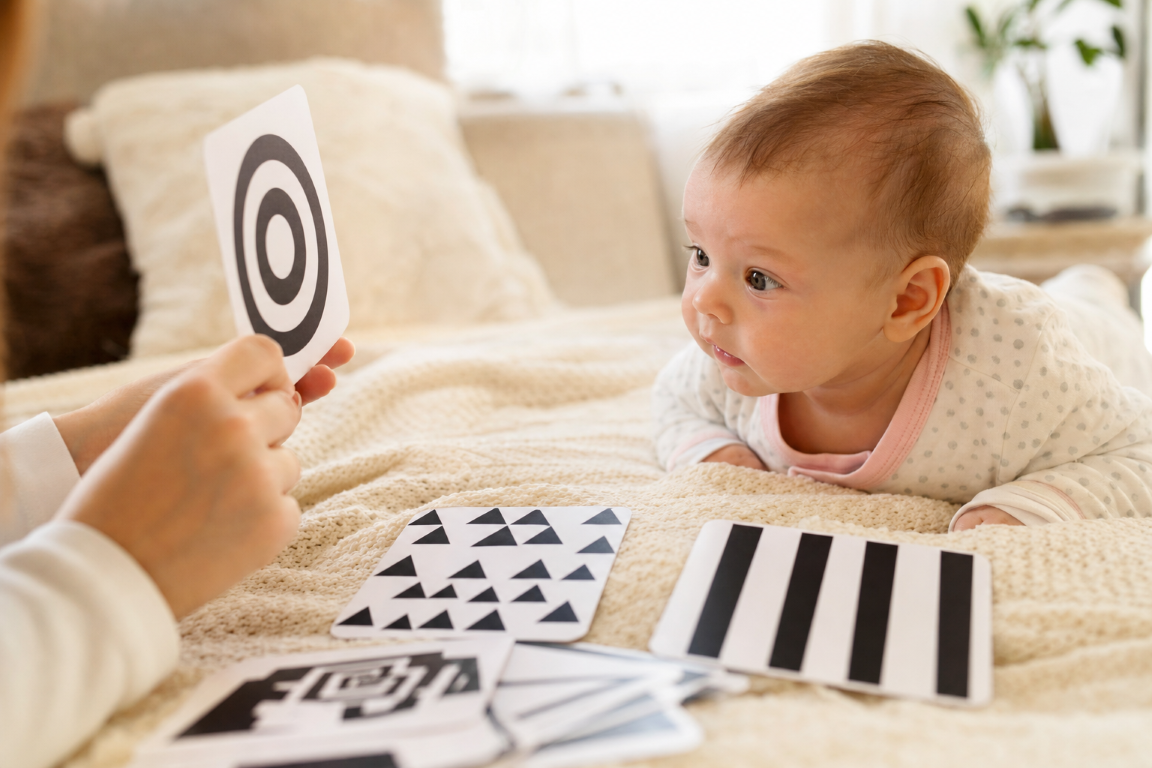
In short: The first year of life is the most eventful in terms of the pace of development. The child goes from complete dependence to the first steps and words. Developmental norms are variable: it is important to look at the big picture, and not at a specific date.
Why follow the development by month
Pediatricians and the WHO identify "windows of development" - age ranges in which most children master certain skills. This data is needed not for competition, but to notice deviations in time and, if necessary, get the help of a specialist.
It is important to remember: premature babies develop according to the adjusted age (from the expected date of delivery), and not from the actual age. A difference of 1-2 months in mastering a skill is the norm for most children.
1 month: first contact with the world
In the first month, the newborn adapts to life outside the womb. His movements are reflexive: sucking reflex, Moro reflex (shudder), grasping reflex. All of them fade away by 3-4 months as the nervous system matures.
- Focuses the gaze on the face at a distance of 25-30 cm
- Reacts to loud noises – flinches or freezes
- Lying on his stomach, he tries to raise his head for 1-2 seconds
- Expresses the state through crying – the only available "language"
During this period, bodily contact is especially important. Skin-to-skin, on-demand feeding, crying response all lay the foundation for secure attachment that affects the baby's development for years to come.
2 months: first smile
Around 6-8 weeks, a conscious social smile appears – one of the most touching and significant moments for parents. The baby begins to recognize loved ones and react to their voice and face differently than to strangers.
- Holds the head at an angle of 45° while lying on the stomach
- Follows the moving object with his eyes
- Makes the first "agu" and guttural sounds
- Calms down at the familiar voice of mom or dad
3 months: opening of hands
A three-month-old baby "opens" his own hands – they come into view, and the child examines them with interest. This is the beginning of hand-eye coordination. He still grabs objects awkwardly, with the whole palm of his hand.
Lying on his stomach, he confidently holds his head, leans on his forearms. This exercise is important for the development of motor skills – daily "tummy time" strengthens the muscles of the back and neck.
- Laughing in response to the game and conversation
- Turns his head to the sound
- Pulling objects into the mouth is normal and important for sensory development
- Begins to distinguish between wet/dry, hungry/full
It is during this period that many families notice the first changes in sleep patterns. Read more about what to expect in the article about sleep norms by age.
4-5 months: flips and the first complementary foods on the horizon
At 4-5 months, most children master flips - first from the back to the stomach, then back. This event requires attention to safety: the child should not be left unattended on high surfaces.
- Reaches and grabs toys with both hands
- Carries an object from hand to hand
- Recognizes his name and turns his head
- Imitates adult facial expressions
- Examines the environment with his eyes, turning his head in all directions
By 6 months, many pediatricians and the WHO recommend considering the start of complementary foods. Read more in the article on when to start complementary foods. Detailed lessons for this period are collected in the material on how to develop a child at 4-6 months.
6 months: sitting with support
Six months is an important starting point. Most children by this age sit independently with minimal support or support. The back can still be rounded - this is normal, the muscles continue to strengthen.
- Sits with little or no support
- He is actively humming, syllable chains appear ("ma-ma-ma", "ba-ba")
- Flips in both directions
- Reacts to the name, recognizes familiar and unfamiliar people
- The first tooth may appear - read about the order of eruption in the article Teeth in children
The norm range according to the WHO: independent sitting is from 4 to 9 months. If the child is not sitting at 9 months, it is worth consulting a pediatrician.
7-8 months: crawling and object constancy
Seven to eight months is a time of active exploration of space. Many children begin to crawl: some in the classic way (on all fours), others in the Plastun way, and still others roll over. All options are acceptable - the main thing is that the child moves and explores the world.
At this age, object constancy is formed – the understanding that an object exists, even if it is not visible. That is why separation anxiety arises: the child knows that his mother "is", but does not see her and gets upset. This is a sign of normal cognitive development.
- Actively crawls or moves in any available way
- Sits confidently without support
- Points his finger at points of interest
- He says "ma-ma", "ba-ba" without reference to specific people
- Afraid of strangers (normal reaction at this age)
Detailed ideas for activities for this period are in the article on how to develop a child at 7-9 months.
9 months: tweezer grip
Nine months is the time of fine motor skills. A tweezer grip appears: the child picks up small objects with his thumb and index finger. This is the most important motor skill, which in the future will become the basis of writing.
Safety requirements are increasing: everything that can fit in the mouth must be removed. The child actively puts everything he finds on the floor into his mouth.
- Stands up, holding on to the support
- Moves along furniture ("cruising")
- Understands the word "no"
- Imitates gestures: claps his hands, waves "bye"
- Looking for a hidden object
10–11 months: stands at the support, first words
At 10-11 months, many children begin to stand without support for a few seconds. The first independent steps can occur as early as 10 months or not until 15 - both options fit into the WHO norm.
- Stands unsupported for 1-3 seconds or longer
- Takes the first steps along the furniture or behind the hand of an adult
- Pronounces 1-2 conscious words with understanding ("mom", "give")
- Fulfills simple requests ("give me", "come here")
- Actively gesticulates, points with his finger
About classes and stimulating games for this stage, see the material on how to develop a child at 10-12 months.
12 months: first birthday
By the age of one, the child has come a tremendous way. WHO averages: height increased by 25 cm, weight tripled. But the main thing is a qualitative leap in cognitive, social and motor development.
- Walks on their own or takes their first confident steps (many start later, before 15-18 months)
- Speaks 1-5 conscious words
- Understands much more than he says
- Plays simple story games (feeds a doll, rolls a car)
- He points to objects and names them
- Shows independence: "I want it myself"
Around this age, many parents notice changes in behavior, which are often referred to as the 1-year-old crisis. This is a normal stage in the development of a child's autonomy.
The WHO normal range for walking is 9 to 15 months. A child who started at 15 months is normal, just like someone who started at 10.
Principles of Developmental Assessment
Pediatricians assess development in four main areas: motor skills (gross and fine), speech, and social and adaptive skills. Breaking multiple lines at once requires attention; Being ahead in one while lagging behind in the other is a reason for observation, but not for panic.
Read more about motor development, speech development , and sensory development in separate articles.
When to see a doctor
See your pediatrician or neurologist if:
- At 2 months, there is no social smile and eye contact
- At 4 months, he does not react to sounds and does not follow with his eyes
- At 6 months, he does not hold his head confidently
- At 9 months, he does not sit with support
- At 12 months, there is not a single conscious word and no pointing gesture
- At any age, the child has lost already mastered skills (regression)
- You are worried about something in the child's behavior or reactions – this in itself is a reason for consultation
Read more about the warning signs in our article Warning signs in development: when to see a doctor.
Frequently Asked Questions
My child did not crawl, but immediately walked - is this normal?
Yes, about 10-15% of children skip the crawling stage and immediately get up and walk. This is a common version of the norm. Crawling is good for coordination, but its absence is not in itself a sign of a developmental disorder.
Do I need to buy educational mats, cards, mobiles?
The most powerful development tool is live communication with a parent. A mat, mobile, and development games can complement this communication, but not replace it. Simple household items (pots, spoons, mirror) work no worse than expensive toys.
When to start learning – from birth or later?
Learning begins at birth - this is talking to the baby, singing, reading aloud, naming objects. Formalized classes are not needed in the first year: at this time, secure attachment, a sense of security and freedom of exploration are more important.
How is development related to sleep and feeding?
Sleep and nutrition are the foundation of development. During periods of mastering new skills, sleep is often disturbed - this phenomenon is called sleep regression. Good nutrition, including the introduction of complementary foods, also affects the pace of development.
Conclusion
The first year of life is a unique period when a child's brain grows and forms millions of connections every day. Development follows its own unique schedule for each baby. Your task is to create a safe, rich environment, respond to the needs of the child and not miss routine examinations with a pediatrician. Norms are needed as a guideline, not as a cause for alarm.
Bibliography
- WHO. (2006). WHO Motor Development Study: Windows of achievement for six gross motor development milestones. Bulletin of the World Health Organization, 84(7), 581–590.
- American Academy of Pediatrics. (2023). Developmental Milestones — HealthyChildren.org.
- Frankenburg W.K. et al. (1992). The Denver II: A major revision and restandardization of the Denver Developmental Screening Test. Pediatrics, 89(1), 91–97.
- Sheridan M.D. (2014). From Birth to Five Years: Children's Developmental Progress. 4th ed. Routledge.
- Doskin, V.A., Pechora, K.L. (2007). Development of young children. Moscow: MCFR.
- Zero to Three. (2016). Brain Development. National Center for Infants, Toddlers and Families.
- Ghassabian A. et al. (2016). Gross motor development and subsequent neuropsychological development at school age. Dev Med Child Neurol, 58(1), 88–94.
This material is for informational purposes only and does not constitute medical advice and is not a substitute for medical advice. If you are concerned about your child's development, consult your pediatrician or pediatric neurologist.