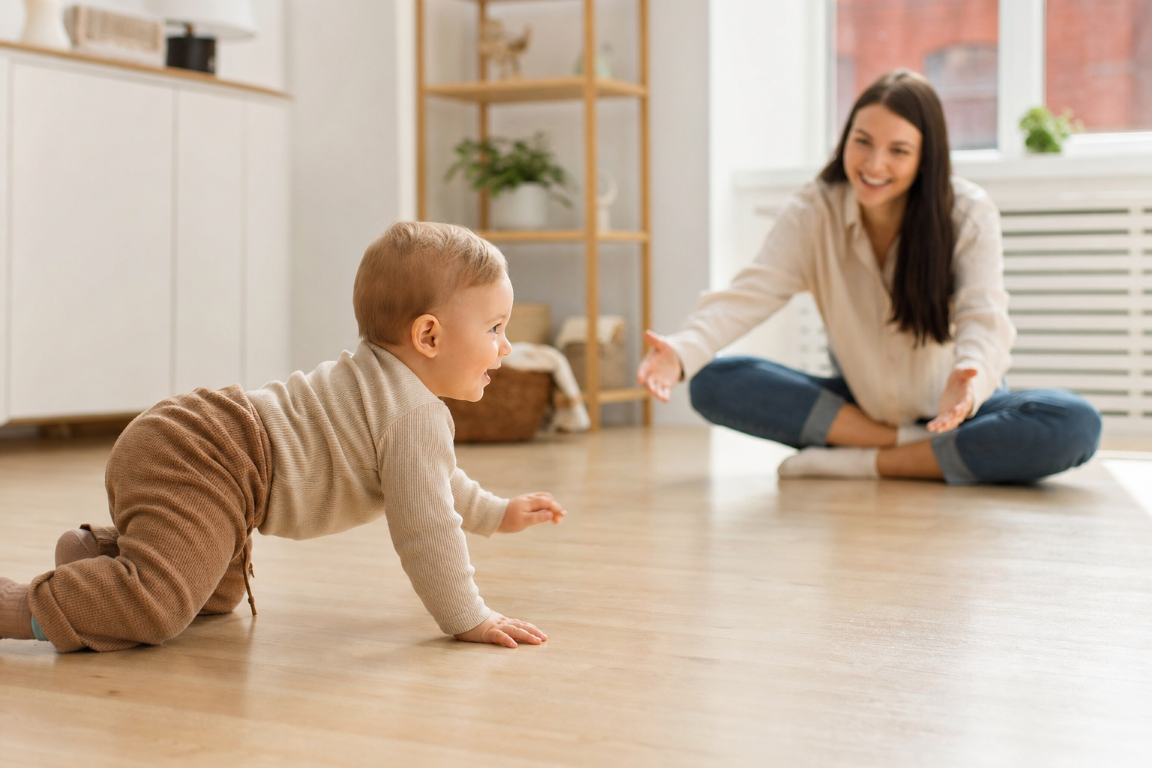
In short: At 4-6 months, the child moves from an "observer" to an "explorer": he learns to roll over, reaches for toys, and actively babbles. This is the time for sensory games and the first complementary foods (if indicated).
What happens at this age
Four to six months is one of the most eventful stages. The reflexes of the newborn fade away, giving way to conscious movements. The brain actively processes sensory information, forms connections between action and result.
The child begins to understand cause-and-effect relationships: if you shake a rattle, it rings. This is the foundation of logical thinking.
For a general picture of development by month, see the article Child Development from 0 to 12 Months.
Motor skills: flips and preparation for sitting
Flipping from back to stomach is a key skill of this period. Games to stimulate it:
- Lying next to the child, slowly move the bright toy to the side - the baby reaches for it and turns over
- Bend his leg – this helps to start the flip
- Increase tummy time to 20-30 minutes a day in total
- Place the toys a little higher so that the baby stretches and raises his head
To prepare for sitting, strengthen the core muscles: help the child move from lying down to sitting, holding the hands (slowly, without jerks). Read more about motor development in a separate article.
Fine Motor Skills: Grasping and Exploring
- Offer toys of different shapes and sizes - the baby learns to grasp and hold
- Hang toys on the arches of the educational mat at arm's length
- Put the toy alternately in your right and left hands – stimulate both sides
- Give different textures: a silicone ring, a fabric toy, a wooden rattle
Everything that the baby puts in his mouth is normal. At this age, the mouth is the main "device" for studying the subject. Just keep an eye on safety: no small details.
Speech: babbling and dialogue
At 4-6 months, cooing turns into babbling - the child begins to combine consonants and vowels. How to maintain:
- Respond to every sound of the child – "talk" with pauses
- Repeat the child's sounds, then add your own
- Sing simple songs with distinct articulation
- Read books with bright pictures and name the images
Read more about speech development and what is important at each age.
Vision: Colors and Tracking
By 4 months, the child sees the entire spectrum of colors. Bright colors now work better than black and white contrasts.
- Slowly move the bright toy - the baby follows with his eyes
- Show the reflection in the mirror – the child is studying the "other baby" with interest
- Walking in a stroller facing forward or in a carrier – a rich visual environment
First complementary foods: preparation
WHO recommends exclusive breastfeeding for up to 6 months. The AAP supported this benchmark in 2022. Starting complementary foods ahead of time requires good reasons and a decision from a pediatrician.
Signs of readiness for complementary foods (usually about 6 months): stable sitting with minimal support, interest in adult food, extinction of the buoyancy reflex. For more information on when to start complementary foods, see the section on complementary foods.
Sleep at this age
At 4 months, many children experience the first noticeable regression of sleep: the structure of sleep changes, night awakenings become more frequent. This is a normal stage in the maturation of the nervous system, and not a sign of hunger or disease.
When to see a doctor
- At 4 months, he does not react to sounds and does not follow a moving object
- At 5 months, he does not reach for toys and does not have enough of them
- At 6 months, it does not turn over in either direction
- No babbling and no reaction to voice
- Pronounced asymmetry of movements
For more information about the signs that need attention, see the article Warning Signs in Development.
Frequently Asked Questions
Is it necessary to put a child in pillows at 4 months?
No. Prop sitting (in pillows, in the corner of the sofa) does not train the muscles and does not speed up independent sitting. It can even be harmful, creating an improper load on the spine. The child will sit down on his own when he is ready.
When to start exercising in the pool?
Infant swimming with an instructor is possible from 1-2 months if the family wishes. It's an enjoyable experience, but there's no evidence of much impact on development. If you feel unwell, an unhealed navel or have any doubts, consult a pediatrician.
Conclusion
At 4-6 months, the child is ready for active exploration of the world. Create opportunities for movement, offer a variety of safe objects, talk and respond to babbling. This is the best development.
Bibliography
- American Academy of Pediatrics. (2023). Developmental Milestones: 4 Months. HealthyChildren.org.
- WHO. (2003). Global Strategy for Infant and Young Child Feeding. Geneva: WHO Press.
- Adolph K.E., Hoch J.E. (2019). Motor Development: Embodied, Embedded, Enculturated, and Enabling. Annual Review of Psychology, 70, 141–164.
- Kellman P.J., Arterberry M.E. (2006). Infant visual perception. In Handbook of Child Psychology, Vol. 2. Wiley.
- Tamis-LeMonda C.S. et al. (2014). Mothers' responses to infant vocalizations. Infancy, 19(4), 375–405.
This material is for informational purposes only and does not constitute medical advice and is not a substitute for medical advice. If you are concerned about your child's development, consult your pediatrician or pediatric neurologist.