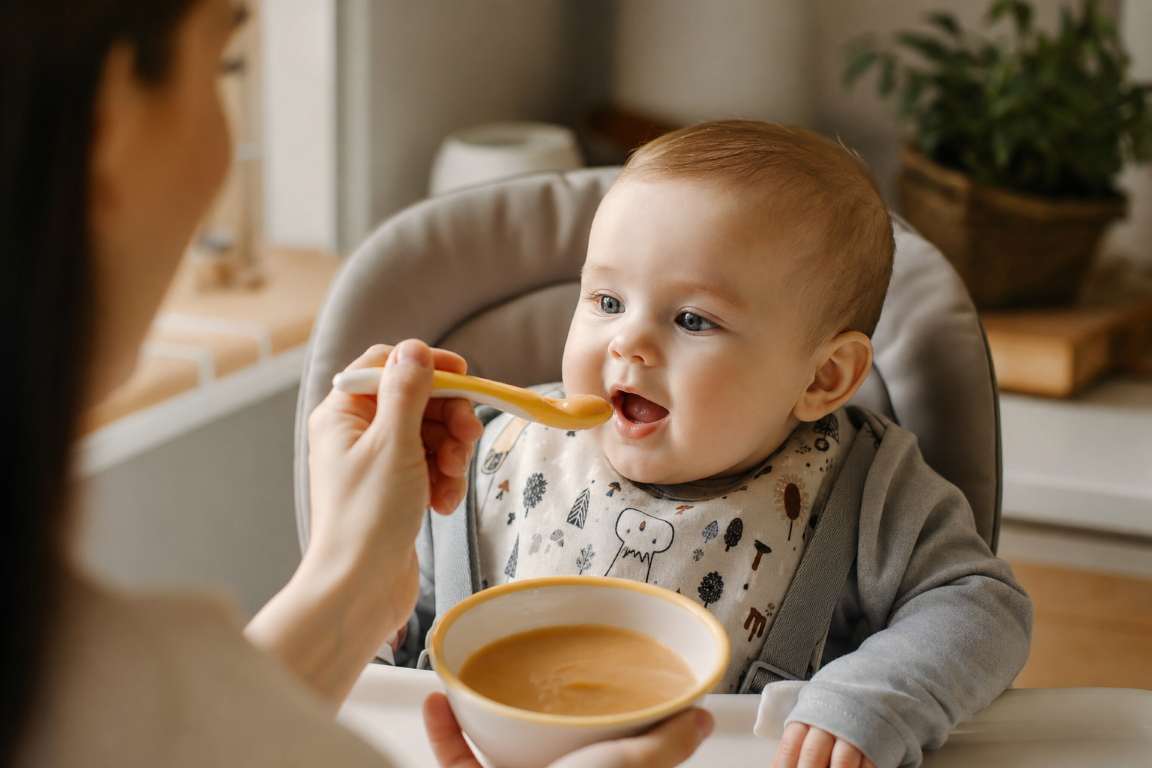
In short: The WHO and most pediatric organizations recommend starting complementary foods around 6 months, no earlier than 4 months. The key guideline is not only age, but also three signs of readiness: the baby confidently holds his head, sits with support and shows interest in adult food.
Why age is just a guideline, not a hard and fast rule
The first question that almost every parent asks at a pediatrician's appointment is: "From what month to give complementary foods?" But there is an important caveat behind this figure: each child develops at his own pace. That is why the first complementary foods are introduced not according to the calendar, but according to a combination of signs of the body's readiness.
The WHO recommends exclusive breastfeeding for up to 6 months and the introduction of complementary foods "about 6 months" with the preservation of breast milk or adapted formula. ESPGHAN (European Society of Paediatric Gastroenterology) specifies: no earlier than 17 weeks and no later than 26 weeks. The AAP (American Academy of Pediatrics) takes a similar position – about 6 months. These are not arbitrary numbers: by this age, most children have matured gastrointestinal tracts, enzymes to digest more complex foods appear, and the physiological reflex of pushing with the tongue disappears.
It is important to understand: "about 6 months" is not "exactly 180 days". In premature babies, they are guided by the adjusted age. If the baby was born 4 weeks prematurely, the pediatrician will take this into account when assessing readiness.
Three key signs of readiness
Experts distinguish three basic signs that must be present at the same time. The absence of at least one is a reason to postpone complementary foods and consult a pediatrician.
1. The child confidently holds his head and sits with support
This does not mean that the baby should sit down on his own. It is enough for him to sit in a highchair or on the lap of an adult without throwing his head back. Head control is needed for safe swallowing: without it, the risk of choking is much higher. If the child's development is at an average pace from month to month, this skill is formed by 4-6 months.
2. Extinction of the tongue push reflex
Newborns have a protective reflex: the tongue automatically pushes everything hard out of the mouth. This is normal and protects against aspiration. By 4-6 months, the reflex fades away, and the baby becomes able to move food to the throat and swallow it. If, when trying to give mashed potatoes from a spoon, the child steadily spits everything back, the reflex is still active, and it is worth waiting 1-2 weeks.
3. Interest in adult food
The baby reaches for the plate, follows the spoon, opens his mouth when he sees how others are eating. This is a behavioral signal of readiness. On its own, it is insufficient (some babies show interest as early as 4 months, although they are not physically ready), but in combination with the first two signs, it is an important confirmation.
What is not a sign of readiness
There are common misconceptions that often push parents to start complementary foods ahead of time. Let's take a look at them one by one.
- "The child does not sleep well at night." Sleep disorders are extremely rarely associated with hunger. If the baby is gaining weight well, the reason for night awakenings is most likely in the neurobiology of sleep, and not in a lack of calories. Read more about this in the article about why a child often wakes up at night.
- "The baby demands the breast too often." Frequent attachments at 3-4 months are, as a rule, a growth spurt or lactation crisis, and not a signal to introduce complementary foods.
- "The child is big / gaining weight well." Body size and growth rate do not affect the maturity of the digestive system.
- "He looks at the food and licks his lips." Such behavior begins early and in itself does not indicate physiological readiness.
- "Grandma says it's time." Recommendations for the timing of complementary foods have changed several times over the past 30 years. Modern standards differ significantly from Soviet ones.
Special situations: when landmarks shift
A number of circumstances require an individual approach and mandatory discussion with a pediatrician.
Premature babies
For children born prematurely, they are guided by the adjusted age (age from the expected date of delivery). However, the physical signs of readiness are also more important than the corrected age. The pediatrician leading the premature baby will give individual recommendations.
Children at Allergic Risk
Previously, it was believed that in the presence of atopic diseases in parents, complementary foods should be postponed. Modern evidence shows the opposite: early introduction of allergenic foods (peanuts, eggs, wheat) within the age norms is more likely to reduce the risk of allergies. Read more in the article about allergy to complementary foods.
Bottle-fed children
The timing of the introduction of complementary foods for infants on formula is the same as for infants on breast milk. There is no reason to start complementary foods earlier just because the baby is receiving formula.
Is it possible to start at 4-5 months?
For medical reasons, sometimes yes, but only after consulting with a pediatrician. You should not make this decision on your own. The digestive system of a child up to 4 months old is not ready to process anything other than milk: the intestinal barrier is still "open", the level of secretory IgA is low, and the activity of amylase is insufficient. Introducing foods before 4 months of age is associated with an increased risk of obesity, gastrointestinal infections, and allergies.
If the child is already 6 months old, and there are no signs of readiness, it is worth telling the pediatrician about it. Sometimes the delay hides alarming signs in development that require the attention of a specialist.
How to get started technically: First time at the table
When all three signs of readiness are present, you can make the first attempt. A few practical recommendations:
- Choose a time when the baby is cheerful and not hungry. A hungry child will demand a breast/bottle rather than trying new things.
- Sit in a chair with back support and a headrest - or keep it upright on your knees.
- Offer a quarter teaspoon of mashed potatoes from a soft spoon - just bring it to your mouth and let the baby decide for himself whether to take it or not.
- Do not insist if he refuses: the first "trials" may take several days.
- After trying, breastfeed or formula as usual – complementary foods at this age complement, not replace, milk.
For more information on which foods to give first and in what order, read the article "How to start complementary foods: first foods by month".
When to see a doctor
- The child is already 7 months old, and he still does not hold his head and is not interested in food.
- After the first attempts at complementary foods, a rash, swelling, vomiting or difficulty breathing appeared.
- The baby choked heavily and coughed for a long time or turned blue.
- The child steadily loses weight or does not gain on the usual feeding.
- If you are not sure whether the baby is ready, it is better to check with the pediatrician once again.
Frequently Asked Questions
If the child is breastfed, is complementary foods needed earlier?
No. Breast milk fully covers the needs of a child up to 6 months. The only exception that a pediatrician can discuss individually is vitamin D and, in some cases, iron. Read more about the compatibility of complementary foods and breastfeeding in a separate article.
Is it necessary to give water when introducing complementary foods?
With the beginning of complementary foods, you can offer a small amount of water (drinking, boiled or bottled for children) - a few sips per meal. This helps to form the skill of drinking. Up to 6 months of age, additional water is not needed for exclusive breastfeeding.
How do you know that the attempt was unsuccessful because of immaturity, and not because of taste?
If the baby pushes the puree with his tongue immediately, without tasting, most likely, the reflex is still active. If it takes it in its mouth, but then spits it out and winces, it's probably due to taste: a new taste is almost always surprising. Try the same product in 1-2 days.
Conclusion
Readiness for complementary foods is not a date in the calendar, but a set of signals: control over the head, an extinguished reflex of pushing with the tongue and interest in food. Most babies reach this point around 6 months of age. There is no need to rush: the digestive system matures at its own pace, and the task of parents is to watch the baby, and not chase numbers. Any doubts will be easily resolved by a pediatrician during a routine examination.
Bibliography
- WHO. Complementary feeding. World Health Organization, 2023. https://www.who.int/health-topics/complementary-feeding
- ESPGHAN Committee on Nutrition. Complementary Feeding: A Position Paper by the European Society for Paediatric Gastroenterology, Hepatology, and Nutrition. J Pediatr Gastroenterol Nutr. 2017; 64(1):119–132.
- AAP. Starting Solid Foods. American Academy of Pediatrics, 2022. https://www.healthychildren.org/English/ages-stages/baby/feeding-nutrition/Pages/Starting-Solid-Foods.aspx
- Fewtrell M, et al. Complementary Feeding: A Position Paper by the European Society for Paediatric Gastroenterology, Hepatology, and Nutrition (ESPGHAN). J Pediatr Gastroenterol Nutr. 2017; 64(1):119–132.
- National Program for Optimizing Feeding of Children in the First Year of Life in the Russian Federation. Union of Pediatricians of Russia, 2019.
- Naylor AJ, Morrow AL (eds). Developmental Readiness of Normal Full Term Infants to Progress from Exclusive Breastfeeding to Introduction of Complementary Foods. LINKAGES Project, 2001.
This material is for informational purposes only and does not constitute medical advice and is not a substitute for medical advice. If you are concerned about your child's development, weight gain, or reaction to the introduction of new foods, you should consult a qualified pediatrician as soon as possible, rather than relying only on information from the Internet.