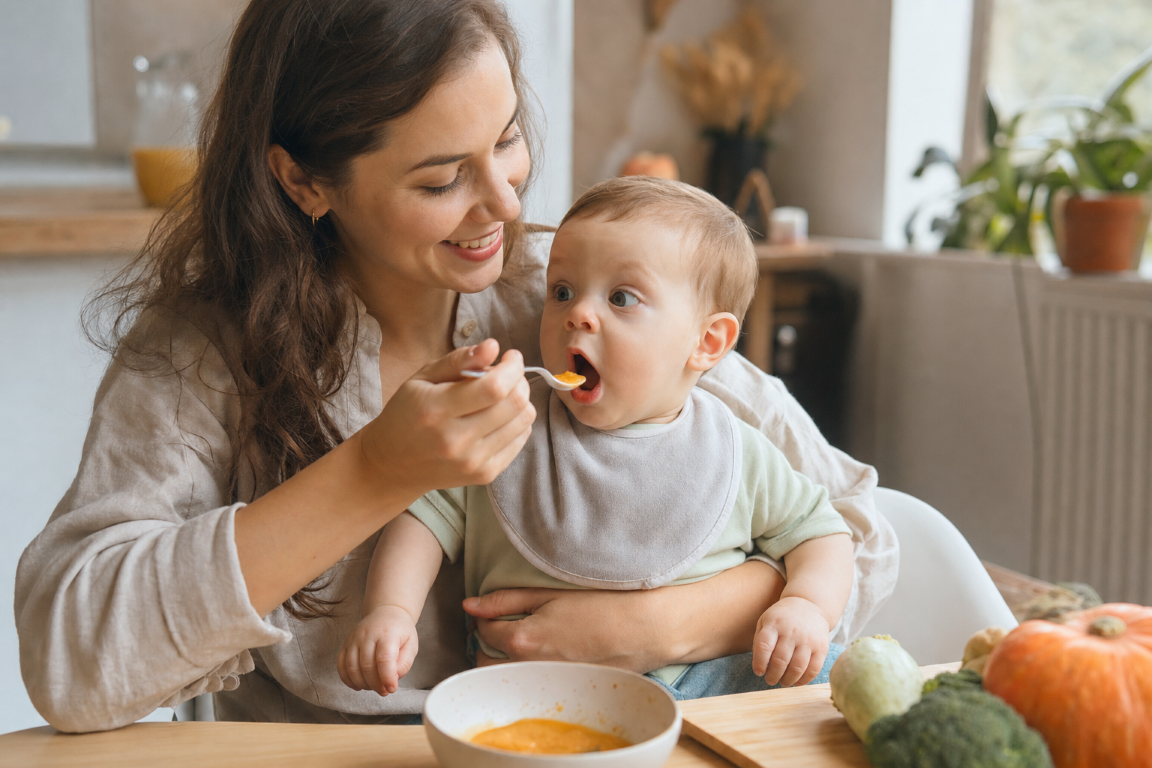
In short: The traditional start of complementary foods is one-component vegetable puree or gluten-free cereals. Each new product is administered separately for 3-5 days. By the age of one, the child can eat most of the products from the common table, except for honey, whole milk as the main drink, salt and sugar.
Why is the order of introducing products important?
When a baby takes his first steps in the world of "adult" food, the main task is not to feed, but to introduce the digestive system to new textures, tastes and proteins. The chaotic introduction of several products at once does not allow you to understand what exactly caused the reaction - whether it is a rash, bloating or loose stools. A systematic approach makes complementary foods safe and predictable. To learn how to understand that the baby is ready for complementary foods, read the article "When to start complementary foods: signs of the baby's readiness".
General rules for the introduction of new products
- One new product every 3-5 days. During this time, allergic or digestive reactions usually have time to manifest themselves.
- Start small: 1/4-1/2 teaspoon. Gradually increase the volume to the age norm.
- Give a new one in the morning: if a reaction occurs, you will have time to notice it and, if necessary, consult a doctor.
- Do not mix unfamiliar products with each other until each of them has been tried separately.
- Complementary foods complement, not replace, breast milk or formula – especially in the first months.
6 months: acquaintance with the first flavors
Most pediatric guidelines recommend starting with vegetable purees or gluten-free cereals on water. Both strategies are equivalent in terms of safety - the choice is determined by the individual characteristics of the child and the recommendation of the pediatrician.
Vegetables
The first to offer are usually low-allergenic vegetables with a neutral taste: zucchini, cauliflower, broccoli, pumpkin. They are easily digestible, contain fiber and practically do not cause allergies. Carrots and potatoes - a little later, as they contain more starch and can put a strain on the immature gastrointestinal tract. Beets are not the first thing: they can stain the stool and urine, which frightens parents.
The puree should be homogeneous, without lumps and spices. Steam or boil, then blend. There is no need to dilute with breast milk or formula, but you can add a little water for the desired consistency.
Gluten-free porridges
If the pediatrician recommends starting with porridge, choose gluten-free options: rice, buckwheat, corn. Cook in water (without milk, salt and sugar). Industrial baby cereals are convenient: they are already enriched with iron and vitamins, which is especially important after 6 months, when iron reserves from mother's milk are depleted. Read more about gluten in complementary foods in a separate article.
Fruit purees
Apple, pear, banana can be introduced in the first month of complementary foods, but it is better after vegetables. Children like the sweet taste of fruit immediately, which sometimes prevents them from accepting less sweet vegetables. Citrus fruits and exotic fruits - no earlier than 8-10 months.
7-8 months: expansion of the diet
By this age, the baby is already familiar with several vegetables and, possibly, cereals. Now you can expand the diet. Read more about this stage in the article "Complementary foods at 7-8 months: expanding the diet".
Meat
ESPGHAN and AAP recommend introducing meat as early as 6-7 months as an important source of heme iron and zinc. They start with low-fat varieties: turkey, rabbit, veal. The meat is mashed until smooth and added to the vegetable puree. About the nuances of this stage - in the article "Meat in complementary foods: when and how to introduce".
Gluten-containing cereals
Oatmeal, wheat and semolina – can be introduced from 6-7 months (no earlier than 4 and no later than 7 months – this is the range offered by ESPGHAN to reduce the risk of celiac disease). Do not postpone gluten "for later": evidence suggests that insertion into the window from 4 to 7 months while continuing breastfeeding can reduce the risk of celiac disease.
Egg yolk
Egg yolk is introduced from 7-8 months: start with 1/4 of the yolk of a boiled egg. Protein – later, not earlier than 9-12 months, as it is more allergenic. Eggs are a potential allergen, so follow the 3-5 day rule.
Fermented milk products
Baby cottage cheese and kefir can be introduced from 8 months. Whole cow's milk as the main drink – no earlier than 12 months (risk of strain on the kidneys and iron deficiency). A small amount of milk in porridge and mashed potatoes is permissible from 8-9 months.
9-12 months: transition to textured food
At this stage, puree is gradually replaced by food with soft pieces: the baby learns to chew with his gums. For more details of this transition, see the article "Complementary foods at 9-12 months: transition to a common table".
Fish is introduced from 9-10 months: they start with lean varieties (cod, hake, pike perch). Fish is an allergen, so follow the same rules. Legumes (lentils, peas) – from 9-12 months, starting with well-boiled ones. Bread, croutons and soft biscuits without salt and sugar – from 8-9 months.
What not to give before one year
- Honey is a risk of botulism (spores of Clostridium botulinum can germinate in the immature intestines of an infant).
- Whole cow's milk as the main drink means a high load on the kidneys, the risk of iron deficiency anemia.
- Salt – immature buds cannot cope with its processing. For more information, see the article "Salt and sugar in baby food".
- Sugar and sweeteners form a habit of sweets, are harmful to tooth enamel.
- Whole nuts and large pieces of solid food are a risk of aspiration.
- Hot spices, marinades, smoked meats, sausages are not intended for baby food.
Industrial or homemade puree?
Both options are suitable for complementary foods. Industrial purees are standardized in texture and composition, convenient on the road. Homemade ones allow you to control the ingredients and accustom them to "family" tastes. A comparison of the pros and cons of each approach is in the article "Canned vs homemade food".
When to see a doctor
- After the introduction of a new product, a rash, hives, swelling of the face or difficulty breathing appeared.
- The child refuses all the proposed products for several weeks.
- The stool changed dramatically: blood, mucus or uncontrollable diarrhea appeared.
- The baby does not gain weight or loses it.
- There is a suspicion of constipation after the introduction of complementary foods.
Frequently Asked Questions
Is it possible to give several products at once?
In the first 2-3 months, complementary foods are not. You can and should mix already tested products with each other: this way the dish becomes more diverse and tastier. A new ingredient is always introduced separately.
Do I need special baby oil?
From 6-7 months, you can add a small amount of unrefined vegetable oil (olive, sunflower) to vegetable puree - about half a teaspoon. Butter – from 7-8 months, 3-5 g per day.
Do we need juices in complementary foods?
The AAP has not recommended juicing children under 1 year of age since 2017. Juices are high in sugar, low in fiber, and low in nutrients compared to whole fruits. If you want to introduce the baby to the taste, it is better to offer mashed potatoes from the same fruit.
Conclusion
Complementary foods are a marathon of acquaintance with food, and not a sprint with mandatory norms. Systematicity (one product - 3-5 days), gradualness (small volumes) and observation are the three pillars of successful introduction of complementary foods. By the age of one, most children can eat a variety of family food, adapted in texture and without "adult" spices. Consult a pediatrician if you have any doubts - the individual characteristics of the child are always more important than any general schemes.
Bibliography
- ESPGHAN Committee on Nutrition. Complementary Feeding: A Position Paper. J Pediatr Gastroenterol Nutr. 2017; 64(1):119–132.
- AAP. Starting Solid Foods. HealthyChildren.org, 2022. https://www.healthychildren.org/English/ages-stages/baby/feeding-nutrition/Pages/Starting-Solid-Foods.aspx
- WHO. Guiding principles for complementary feeding of the breastfed child. PAHO/WHO, 2003.
- National program for optimizing the feeding of children in the first year of life in the Russian Federation. Union of Pediatricians of Russia, 2019.
- Fewtrell M, et al. Optimal duration of exclusive breastfeeding: what is the evidence to support current recommendations? Am J Clin Nutr. 2011; 93(6):1256S–1262S.
- Greer FR, et al. Effects of early nutritional interventions on the development of atopic disease. Pediatrics. 2019; 143(4):e20190281.
This material is for informational purposes only and does not constitute medical advice and is not a substitute for medical advice. If you're concerned about your child's reaction to new foods, weight gain, or stool, it's important to see your pediatrician rather than relying solely on information from the internet.