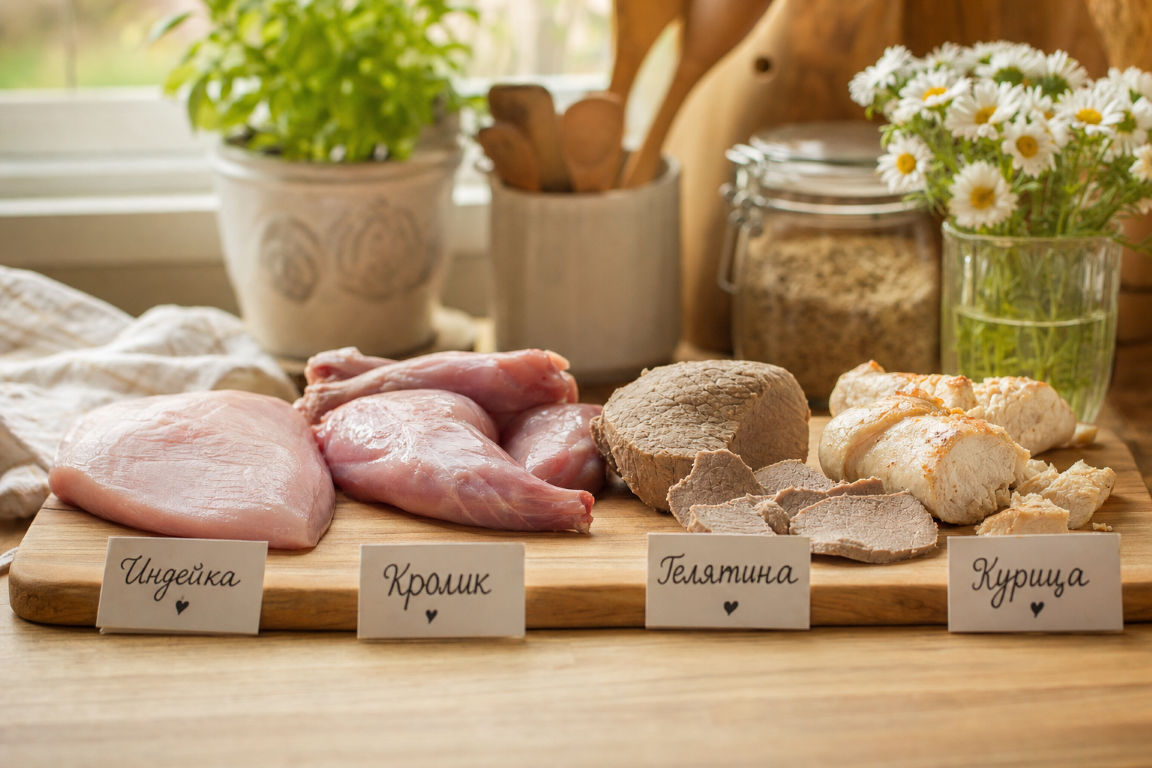
In short: ESPGHAN and AAP recommend introducing meat from 6-7 months as a priority source of heme iron and zinc. Start with turkey, rabbit or veal: 5-10 g in the first days, gradually to 30-50 g by 9-10 months. Meat must be thoroughly cooked and ground to a homogeneous state.
Why meat is important for a first-year-old child
Iron reserves accumulated in the womb are exhausted by 4-6 months. Breast milk contains iron in a highly bioavailable form, but its absolute amount does not cover the growing needs of a child over 6 months old. Iron deficiency anemia is one of the most common problems of children in the first year of life and has a negative impact on neurocognitive development, immunity and general tone.
Meat contains heme iron, a form that is absorbed 2 to 3 times better than non-heme iron from plant foods. In addition, meat is a source of well-absorbed zinc, which is necessary for growth and immune function, and complete protein with all essential amino acids.
Which meat to start with
Low-fat, low-allergenic varieties are recommended first:
- Turkey is lean, tender, low-allergenic, rich in protein and iron.
- Rabbit is a hypoallergenic variety with an excellent nutrient profile, recommended for allergiesand.
- Veal is a good source of heme iron and zinc.
- Chicken (white meat) – can be introduced a little later: some children with an allergy to chicken eggs have a cross-reaction to chicken meat (requires caution).
- Beef – from 7-8 months: richer in iron than poultry, but slightly tougher in texture.
Pork, lamb, by-products (liver) are introduced later - from 8-10 months. Sausages, sausages, semi-finished products are not recommended for children under 3 years of age: they contain salt, nitrites, and additives.
How to cook meat for complementary foods
- Boil the meat until fully cooked (without salt and spices). Veal and beef are cooked longer - 40-60 minutes.
- Cool and cut into small pieces, removing tendons and films.
- Blend until completely homogeneous. Add a little broth or water for just the right thickness.
- Mix with the already familiar vegetable puree - this makes it easier for the child to accept the new taste.
By 9-10 months, when the child learns to chew with gums, you can offer meat in the form of minced meat or tender steamed meatballs. About the change of texture - in the article "Complementary foods at 9-12 months".
Volumes by age
- 7 months: 5-10 g (1-2 teaspoons) per day.
- 8 months: 20-30 g per day.
- 9-10 months: 30-40 g per day.
- 11-12 months: 40-60 g per day.
Meat is included in the diet 5-6 times a week; Fish days (1-2 times a week) replace meat. About the general order of products - in the article "How to start complementary foods: first products".
When to see a doctor
- After the introduction of meat, a rash, stool upset or other signs of allergy appeared.
- The child consistently refuses meat dishes, is pale and lethargic - iron deficiency is possible.
- The pediatrician identified anemia and prescribed an additional iron-containing drug - this does not cancel meat in the diet, but complements it.
Frequently Asked Questions
Does a vegetarian child need meat?
If the family is vegetarian, meat replacement requires careful planning: adequate iron (from legumes fortified cereals), zinc, and vitamin B12 (through supplements) must be provided. Consultation with a pediatrician or pediatric nutritionist is mandatory.
Can liver be given?
Liver is a rich source of iron and vitamin A, but it is administered with caution from 8-9 months and no more than 1-2 times a week: excess vitamin A is toxic to children.
Conclusion
Meat is not just a taste variety, but the most important nutrient priority of the second half of life. Introduce it in a timely manner (from 6-7 months), start with low-allergenic varieties, cook without salt and spices and gradually increase the volumes. This is one of the best steps you can take to prevent iron deficiency in your baby.
Bibliography
- Domellof M, et al. Iron Requirements of Infants and Toddlers. J Pediatr Gastroenterol Nutr. 2014; 58(1):119–129.
- ESPGHAN Committee on Nutrition. Complementary Feeding: A Position Paper. J Pediatr Gastroenterol Nutr. 2017; 64(1):119–132.
- National program for optimizing the feeding of children in the first year of life in the Russian Federation. Union of Pediatricians of Russia, 2019.
- WHO. Guiding principles for complementary feeding of the breastfed child. PAHO/WHO, 2003.
- Ziegler EE. Consumption of cow's milk as a cause of iron deficiency in infants and toddlers. Nutr Rev. 2011; 69 Suppl 1:S37–42.
This material is for informational purposes only and does not constitute medical advice and is not a substitute for medical advice. Discuss an individual plan for the introduction of meat and other complementary foods with a pediatrician.