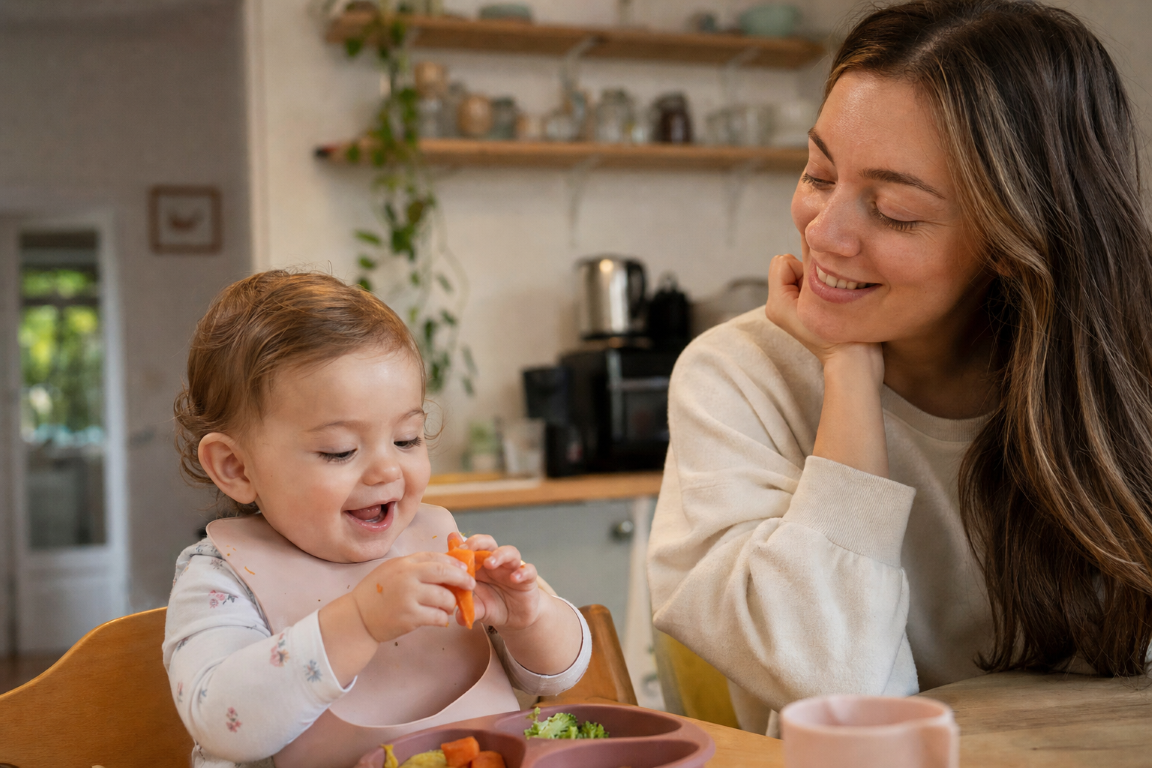
In short: Refusal to eat complementary foods is a very common situation. Most often, the reason is not that the child is "harmful", but in immature readiness, poor health or the wrong moment. Pressure and coercion exacerbate the problem. Patience, variety, and a positive atmosphere are the best strategy.
Why a child refuses: common reasons
Physiological immaturity
If the baby has just turned 6 months old, but he is still pushing out the puree with his tongue, perhaps the pushing reflex is still active. This is not stubbornness, but a neurophysiological reality. Wait 1-2 weeks and try again. About the signs of readiness for complementary foods - in the article "When to start complementary foods".
The child is not hungry
Complementary foods are offered when the baby is cheerful and slightly hungry - not immediately after breastfeeding / formula (full) and not at the time of severe hunger (will require breasts). Try to change the time of offering complementary foods.
Feeling unwell
Teething, SARS, colic, change of scenery - all this reduces appetite. During such periods, do not insist: the baby will return to food when he recovers. Colic has a particularly strong effect on eating behavior in the first months.
Food Neophobia
Fear of the new is a biologically grounded reaction. Studies show that on average, it takes 8-15 offers of the same product before a child accepts it. This is the norm, not a whim. Don't give up after the first or second rejection.
Inappropriate texture or temperature
Some children refuse to puree that is too liquid, while others refuse to puree that is too thick. Someone does not tolerate warm food, someone does not tolerate room temperature. Experiment with consistency and temperature.
What NOT to do in case of refusal
- Do not force or "stuff". Compulsion to eat is a proven risk factor for eating disorders in the future. Food should never be associated with stress.
- Do not show anxiety. Children read parental stress well and may refuse to eat, including because of the tense atmosphere at the table.
- Do not give another as a "replacement". If you give up vegetables, do not immediately compensate with sweet fruits or breasts: this will only consolidate the refusal.
- Do not arrange an "air show" with a spoon. Entertainment during meals distracts from the signals of hunger and satiety.
What helps with rejection
- Repeat sentences. 8-15 times is the norm. Put a small amount on the plate each time, even if the child is not eating – visual familiarity also counts.
- Eat together. A child at the common table sees how adults eat and imitates. This is one of the most powerful incentives to embrace new things.
- Change the form of presentation. If you refuse to puree zucchini - offer baked zucchini in a piece. Or mix with your favorite product.
- Let them explore the food with their hands. Touching, crumpling, smearing is not pampering, but a way of cognition. BLW elements help children adopt new foods.
- Take your time. If the child gains weight well on breast milk / formula, a few weeks of active refusal of complementary foods are not dangerous. Ask your pediatrician to be sure.
Protracted Failure: When It Becomes a Problem
Most cases of refusal are a temporary situation that resolves itself as the baby grows up. However, there are signs in which it is worth contacting a specialist.
If the child takes only liquid food or breasts after 10-11 months, if he reacts to new foods by screaming and vomiting (and not just pushing with his tongue), it may be a sensory food sensitivity or another condition that requires professional evaluation. Monitor the development of the child at 7-9 months in general.
When to see a doctor
- A child over 10 months old takes only liquid products or breasts.
- When trying to give solid food, vomiting occurs.
- The baby does not gain weight.
- Refusal is accompanied by severe anxiety, crying or pain reactions.
- You notice warning signs in development in general.
Frequently Asked Questions
Is it necessary to force-feed if the child does not eat anything for several days?
No. If the baby continues to receive enough breast milk or formula and gains weight well, a few days without complementary foods are not harmful. Compulsion to eat harms much more.
Does adding sugar or salt help make food "tastier"?
No. Salt and sugar are not recommended until the age of one year and are not needed to improve the taste: children have a different perception of taste, and neutral vegetables are quite tasty for them. The addition of salt and sugar creates unhealthy food preferences. For more information, see the article "Salt and sugar in baby food".
Conclusion
Refusal of complementary foods is normal, predictable and temporary in most cases. The main thing is not to turn food into a battlefield. Patient repeated suggestions, a positive atmosphere at the table, and respect for the child's signals are the best strategy for developing healthy eating behaviors for years to come.
Bibliography
- Birch LL, Marlin DW. I don't like it; I never tried it: effects of exposure on two-year-old children's food preferences. Appetite. 1982; 3(4):353–360.
- Satter E. Child of Mine: Feeding with Love and Good Sense. Bull Publishing, 2000.
- Nicklaus S. Development of food variety in children. Appetite. 2009; 52(1):253–255.
- ESPGHAN. Complementary Feeding: A Position Paper. J Pediatr Gastroenterol Nutr. 2017; 64(1):119–132.
- National program for optimizing the feeding of children in the first year of life in the Russian Federation. Union of Pediatricians of Russia, 2019.
This material is for informational purposes only and does not constitute medical advice and is not a substitute for medical advice. If the refusal of complementary foods is accompanied by weight loss, vomiting or alarming signs in development, consult a pediatrician.