In short: At 7-9 months, the child begins to move actively, understands the constancy of objects and masters the first complementary foods. This is the time when ordinary household items are the best toys.
What can a baby do at 7-9 months
This period is rich in achievements: the child sits confidently, begins to crawl, gets on all fours and rocks. The speech repertoire expanded: canonical babbling appeared ("ba-ba-ba", "ma-ma-ma"). Socially: anxiety when separated from loved ones and fear of strangers increases.
For a general picture of development by month, see the article Child Development by Month.
Crawling and locomotion games
Crawling is the most important skill of this period. How to stimulate:
- Create a safe space on the floor without sharp corners and small objects
- Put your favorite toy a little further out of reach - motivate them to crawl
- Make an "obstacle course": pillows, low sides
- Crawl next to you yourself - the baby repeats with pleasure
- Put a mirror against the wall – the child loves to crawl to his reflection
Read more about the stages of motor development in a separate article.
Object Persistence: Hide and Seek
Around 8-9 months, the child understands that the object exists, even if it is not visible. This is the cognitive leap described by Piaget. On its basis, separation anxiety appears (mom is gone, but she "is"), as well as a love of playing hide-and-seek.
- "Peek-a-boo" is a classic game of object constancy: hide your face behind your hands or a handkerchief
- Hide the toy under the handkerchief in front of the child - let him find it
- Roll the ball under the sofa and ask: "Where is the ball?"
- Hide yourself (go out and enter the room) – the child is learning: the mother leaves, but returns
Fine motor skills and tweezer grip
By 9 months, many children master the tweezer grip - they take a small object with their thumb and index finger. How to train:
- Pieces of food on a tray (complementary food): soft cubes of banana, boiled carrots
- Shifting small objects (under supervision!): caps, large buttons
- Container Game: Put Items Inside and Pull Them Out
- Turning the pages of thick cardboard books
Games with different textures and temperatures help to stimulate sensory development .
Speech: babbling and understanding
- Name everything you do: "I open the refrigerator", "here's a red ball", "mom will be back soon"
- Read simple picture books and show: "Where is the dog?"
- Learn gestures: "no", "bye", "give", "more" – gestures precede words
- Sing songs with simple movements ("top-top", "ladushki")
Household items are the best toys
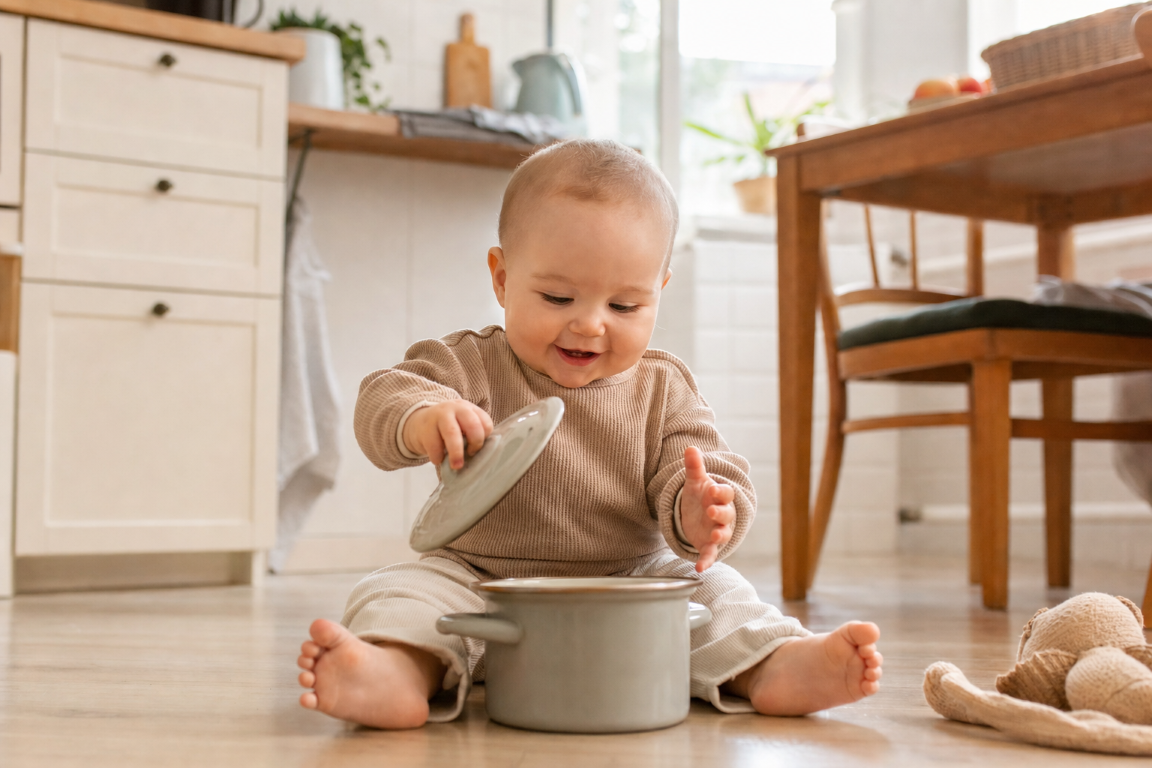
At 7-9 months, the child is attracted to ordinary objects: wooden spoons, pots with lids, plastic containers. They are safer (under control), richer sensory and give a sense of the "real". Special toys are not necessary, although they are pleasant.
For more information about games for this age, see the article games for development under one year.
Complementary foods: expanding the diet
At 7-9 months, complementary foods have already been introduced or are being actively introduced. A variety of flavors and textures is an important part of development. Offer new products (one at a time) and do not pressure: the child has the right to refuse.
Information about complementary foods at 6 months can be found in the section complementary foods at 6 months.
When to see a doctor
- At 9 months, he does not sit with minimal support
- No babbling ("ba-ba-ba", "ma-ma-ma")
- Not interested in toys and surroundings
- No smile in response to a smile
- Very pronounced fear or complete lack of reaction to strangers
For more information about the signs that require consultation, see the article Warning Signs in Development.
Frequently Asked Questions
The child does not crawl - he goes straight to getting up. Is this a problem?
No, this is a variant of the norm. Some children skip crawling or do it in an atypical way (in Plastun, "bear"). If the child is actively moving and development in other areas is normal, there is no reason for concern.
How to deal with separation anxiety?
Separation anxiety is a normal sign of good attachment. Warn the child about leaving ("mom will leave and come back now"), observe the rituals of saying goodbye and meeting. Read more about emotional development in a separate article.
Conclusion
Seven to nine months is the time of active research. Create a safe space, offer a variety of objects, name everything around. Do not rush and do not restrain - trust the pace of your child.
Bibliography
- Piaget J. (1952). The Origins of Intelligence in Children. New York: International Universities Press.
- American Academy of Pediatrics. (2023). Developmental Milestones: 9 Months. HealthyChildren.org.
- Adolph K.E. et al. (2012). How do you learn to walk? Thousands of steps and dozens of falls per day. Psychological Science, 23(11), 1387–1394.
- Hart B., Risley T. (1995). Meaningful Differences in the Everyday Experience of Young American Children. Paul H. Brookes Publishing.
- ESPGHAN. (2017). Complementary Feeding: A Position Paper by the European Society for Paediatric Gastroenterology, Hepatology, and Nutrition. JPGN, 64(1), 119–132.
This material is for informational purposes only and does not constitute medical advice and is not a substitute for medical advice. If you are concerned about your child's development, consult your pediatrician or pediatric neurologist.