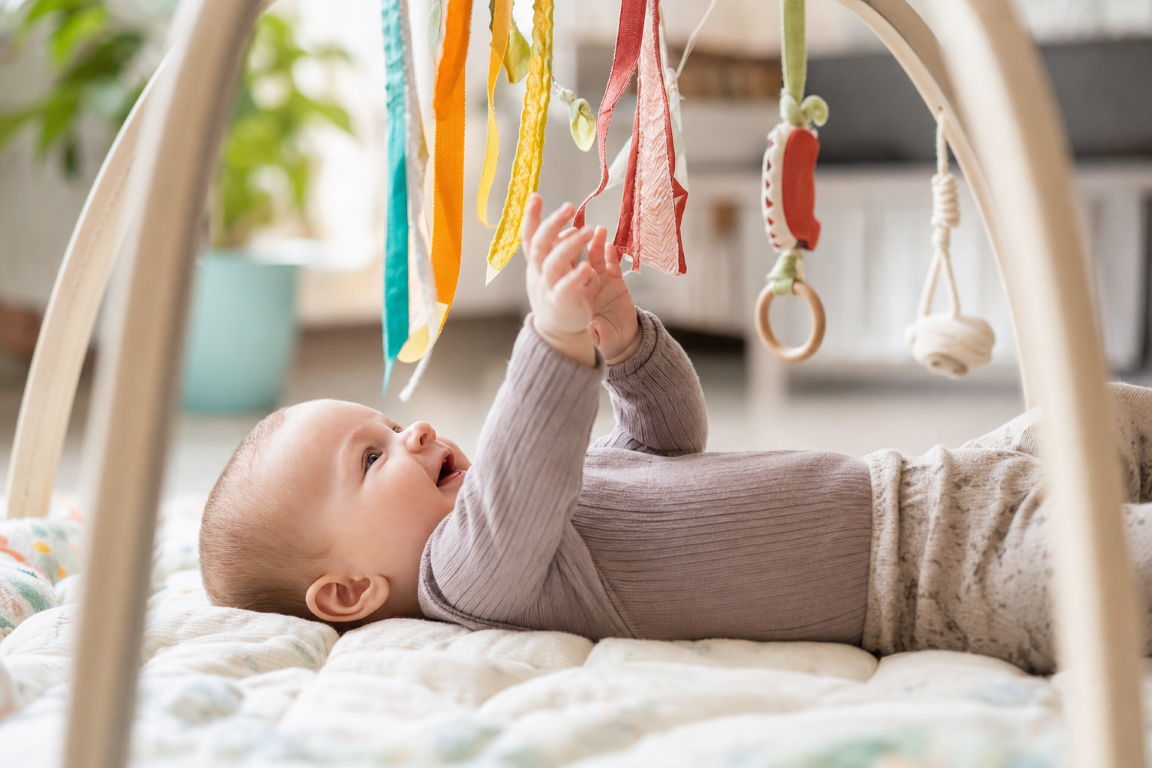
In short: Sensory development is how the brain processes information from all the senses. The most powerful sensory stimulation is ordinary life: walking, eating, bathing, talking. Specialty games complement, but not replace, the daily experience.
Why Sensory Development Is Important
In the first two years of life, the brain processes sensory information at an incredible speed, forming neural connections. A rich sensory environment literally builds the brain. Poor - slows down this process.
Sensory processing is the foundation for everything else: motor development, speech, cognitive skills, and emotional regulation. A child who receives a variety of sensory impressions copes better with new situations.
Vision: how it develops and what stimulates
- 0–1 month: sees 25–30 cm, responds better to contrast (black and white patterns). Hang black and white cards at the feeding and swaddling area
- 2-3 months: follows a moving object. Slowly move a bright subject in the field of view
- 4-5 months: sees colors. Bright toys, colorful ribbons
- 6-12 months: vision almost like that of an adult. Books with bright illustrations, games with a mirror
Hearing: From Voice to Music
- Talk to your child – the voice of a close adult is more important than any music
- Use different intonations and pace of speech
- Sing – simple melodies with repetition are great for developing auditory memory
- Sound natural sounds on a walk: birds, rain, wind
- Simple musical instruments (tambourine, xylophone) from 9-10 months
- Rattles and rattles are the first "auditory" toys
Touch: tactile games
The skin is the largest sense organ. Tactile sensations are critical for the development of:
- Carrying in your arms and in a sling is a rich tactile experience
- Massage for babies – stroking, light pressing, vibration
- Toys made of different materials: fabric, silicone, wood, rubber
- Playing with water when bathing: pouring, splashing, foam
- Sensory boxes (from 9 months): cereals, boiled pasta, jelly, kinetic sand
- Walking without gloves (in warm weather): grass, sand, tree bark
Taste and smell: important senses
Taste preferences are formed in the womb (through amniotic fluid) and through breast milk. A varied diet of a nursing mother introduces the baby to many tastes in advance.
With the start of complementary foods: offer different flavors without sugar and salt. A child who is familiar with different tastes before 1 year of age is easier to accept new foods later. Read more about complementary foods at 6 months and possible allergies to complementary foods.
Vestibular Sense: Movement and Balance
The vestibular system is the sense of balance and position of the body in space. It develops through movement:
- Rocking on your hands, in a sling, cradle
- Turning and lifting "upside down" (gently, with support)
- Swing in the park from 6 months (children's, with support)
- Crawling on uneven surfaces (pillows, mattresses)
Proprioception: Feeling Your Own Body
Proprioception is the feeling of the position of body parts in space. It develops through deep pressure and active movements. Help: hugs with light pressure, tight swaddling (not as a fixation, but as a soothing ritual), crawling and climbing.
Sensory Overload: How to Recognize
Sometimes the child receives too many stimuli and is "overloaded". Signs: turns away from toys and people, begins to cry, yawns, rubs his eyes, arches. This is a signal: you need a break. Give silence, dim the lights, shake – help the nervous system calm down.
When to see a doctor
- The child does not respond to sounds or bright light
- Avoids tactile contact – does not like touch
- Reacts very acutely to normal sensory stimuli (the sound of a vacuum cleaner causes panic)
- Always looking for intense stimulation and not satiated
Atypical sensory processing can be a sign of developmental disorders. For more details, see the article Warning Signs in Development.
Frequently Asked Questions
Do I need to buy special sensory kits?
No. Everything you need is at home: kitchen items, cereals, fabrics, water. Special kits are convenient, but not necessary. Playing with food during complementary foods is a great sensory stimulation.
How often do we need sensory games?
Every day – but this does not mean that you need to plan a "sensory hour". Changing a diaper, bathing, walking, feeding is already a sensory experience. Special games are a nice addition, 10-15 minutes a day is enough.
Conclusion
Sensory development does not require special classes – it requires a diverse life. Your presence, live communication and a rich ordinary environment give the child everything he needs. Special games are enjoyable and useful as an addition.
Bibliography
- Ayres A.J. (1979). Sensory Integration and the Child. Los Angeles: Western Psychological Services.
- Shore R. (1997). Rethinking the Brain: New Insights into Early Development. New York: Families and Work Institute.
- Kellman P.J., Arterberry M.E. (2006). Infant visual perception. In Handbook of Child Psychology. Wiley.
- Trehub S.E. (2001). Musical predispositions in infancy. Annals of the NY Academy of Sciences, 930, 1–16.
- Field T. (2010). Touch for socioemotional and physical well-being. Developmental Review, 30(4), 367–383.
This material is for informational purposes only and does not constitute medical advice and is not a substitute for medical advice. If you have questions about your child's sensory development, ask your pediatrician or occupational therapist.