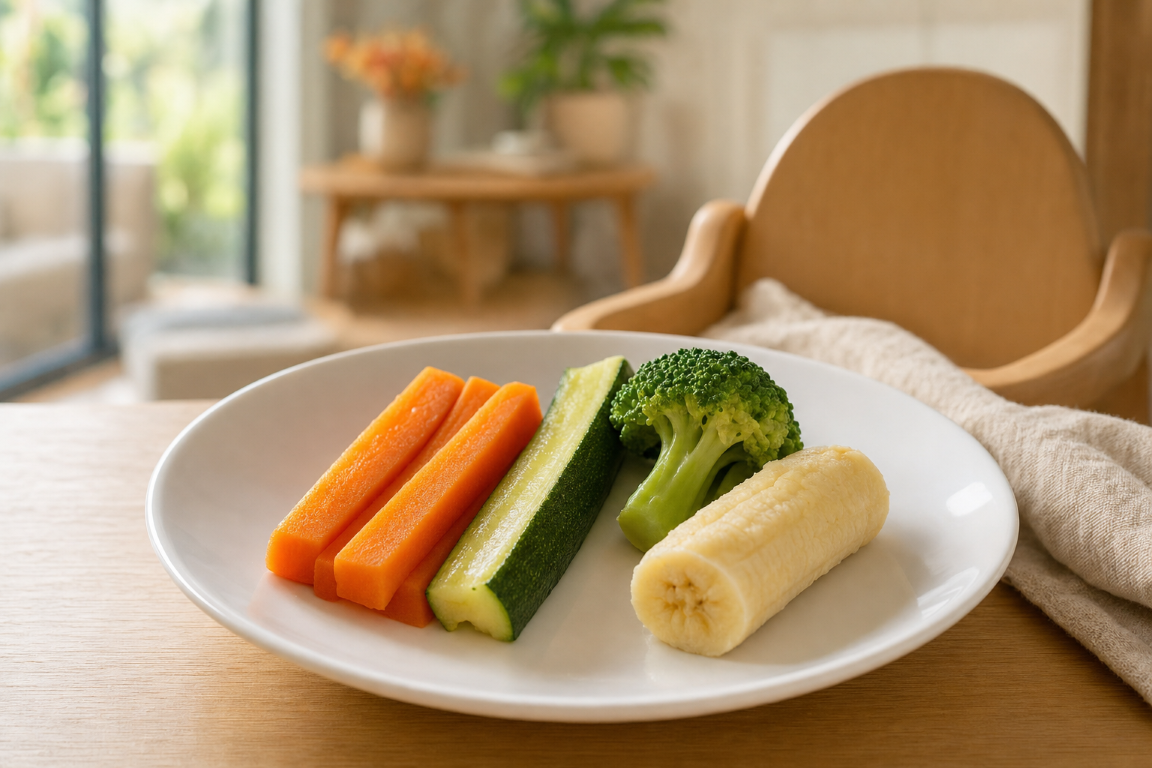
In short: BLW is an approach in which a child from 6 months old takes soft pieces of food on his own and eats as much as he wants. The method develops independence, motor skills and nutritional competence. It requires strict safety rules and is not suitable for children with certain health conditions.
What is BLW and where did it come from?
Baby-led weaning is a term popularized by British nurse Jill Rapley in the 2000s. The bottom line: instead of spoon-feeding the baby with puree food, parents offer him soft pieces that he takes, examines and eats himself. The child himself regulates the amount of food he eats – no "open your mouth, an airplane is flying".
BLW doesn't mean giving up the spoon entirely. "BLW with a spoon" (spoon-feeding BLW) is a compromise option: the spoon is placed in front of the baby, and he takes it himself, dips it in mashed potatoes and carries it to his mouth. Many families combine classic BLW with elements of traditional complementary foods – this is the so-called "hybrid" approach.
About the differences between BLW, pedagogical complementary foods and the traditional approach - in the article "Pedagogical complementary foods vs traditional".
BLW Pros: What Science Says
- Development of motor skills. Grasping, bringing to the mouth, chewing is an active training of fine and gross motor skills, hand-mouth coordination.
- Self-regulation of appetite. A number of studies (Daniels et al., 2015; Townsend & Pitchford, 2012) shows that children on BLW are less likely to overeat and feel fuller better.
- Reduction of food neophobia. Greater exposure to a variety of textures and flavors from an early age may reduce dietary selectivity at 2 to 3 years of age.
- Inclusion in a family meal. The child eats the same as the family (adapted) – the social aspect of nutrition is formed.
Risks and Limitations of BLW
- Risk of aspiration. The main fear of parents is that the child will choke. It is important to distinguish between pressure (gag reflex), which is a normal protective reflex, and aspiration (choking), which is a real blockage of the airways. Pressure in BLW happens often and this is normal; aspiration is rare, but requires an immediate response.
- The risk of insufficient iron intake (for more information about products, see the article "How to start complementary foods"). A number of studies record that with pure BLW, children can consume less iron than with traditional complementary foods with fortified cereals. Solution: include meat from 6-7 months.
- Dirt and unpredictability. BLW is a mess. A lot of food will end up on the floor, on the chair and on the child. This is normal and does not mean that the baby "did not eat".
- Difficulty in estimating the amount of food eaten. It is impossible to accurately calculate how many calories the baby actually received - especially in the first months.
Who is BLW not suitable for?
The method requires caution or is contraindicated in the following cases:
- Swallowing disorders (dysphagia, neurological features).
- Prematurity with a significant delay in motor development.
- Underweight gain – when precise control of your nutritional intake is critical.
- Lack of the skill of independent sitting with support.
Discuss the choice of approach with your pediatrician, especially if your child has health or developmental concerns.
How to Start a BLW: Practical Steps
- Make sure the child is ready. The baby sits with support, holds his head, reaches for food, the reflex of pushing with the tongue has faded. Signs of readiness are described in the article "When to start complementary foods".
- Prepare the correct shape of the meal. The pieces should be large enough for the child to clench in his fist (3-4 cm), and soft enough to easily knead with his fingers. Boiled or baked vegetables (carrots, zucchini, broccoli), soft fruits (banana, pear), meat in the form of soft strips.
- Sit next to me. A child should never eat alone. An adult is always nearby, in the line of sight.
- Do not panic under pressure (gag). The child coughs, pushes food out with his tongue – this is a normal defense mechanism. Do not pat on the back if the baby coughs and blushes: he copes on his own.
- Call an ambulance during aspiration. If the child is silent, pale or blue, does not breathe or breathes with effort, this is aspiration, an emergency.
Safe and Dangerous Products for BLW
Safe (soft, easy to chew with gums): boiled carrots, zucchini, pumpkin, broccoli; soft banana, pear, avocado; meat strips of boiled veal, turkey; bread crusts without salt; The cheese is soft.
Dangerous (risk of aspiration – avoid up to 4-5 years of age in whole form): grapes, cherries (round, slippery); raw carrots, apples; whole nuts; round sausages; popcorn, chips; hard caramel.
When to see a doctor
- The child choked seriously: turned blue, fell silent, did not breathe - immediately call an ambulance.
- The baby does not gain weight against the background of BLW.
- After the introduction of a new product, an allergicreaction appeared.
- If you doubt whether your child is ready for BLW, consult your pediatrician.
Frequently Asked Questions
Can you combine BLW and mashed potatoes?
Yes. The hybrid approach (BLW + spoon) is the most common in real practice. Some dishes are offered in the form of pieces, others in the form of mashed potatoes from a spoon. This does not contradict the principles of any of the methods.
Do parents need special training?
It is advisable to familiarize yourself with the first aid technique for aspiration (Heimlich's technique for infants). This is useful regardless of the method of complementary foods.
Conclusion
BLW is an evidence-based, but preparation-required approach to complementary foods. It is good for children who are physically ready to eat on their own, and for families who are ready for disorder and constant presence nearby. The method develops independence and healthy eating behavior, but does not replace regular monitoring of weight gain and nutrient status. Consult your pediatrician before starting.
Bibliography
- Rapley G, Murkett T. Baby-Led Weaning: Helping Your Baby to Love Good Food. Vermilion, 2008.
- Daniels L, et al. Baby-Led Introduction to SolidS (BLISS) study: a randomised controlled trial. BMC Pediatrics. 2015;15:179.
- Townsend E, Pitchford NJ. Baby knows best? The impact of weaning style on food preferences and body mass index in early childhood in a case-controlled sample. BMJ Open. 2012; 2:e000298.
- Brown A, Lee M. Maternal control of child feeding during the weaning period: differences between mothers following a baby-led or standard weaning approach. Matern Child Nutr. 2011; 7(2):113–125.
- ESPGHAN. Complementary Feeding: A Position Paper. J Pediatr Gastroenterol Nutr. 2017; 64(1):119–132.
- AAP. Starting Solid Foods. HealthyChildren.org, 2022.
This material is for informational purposes only and does not constitute medical advice and is not a substitute for medical advice. Before starting BLW, discuss the method with your pediatrician, especially if your child has a developmental or health condition.