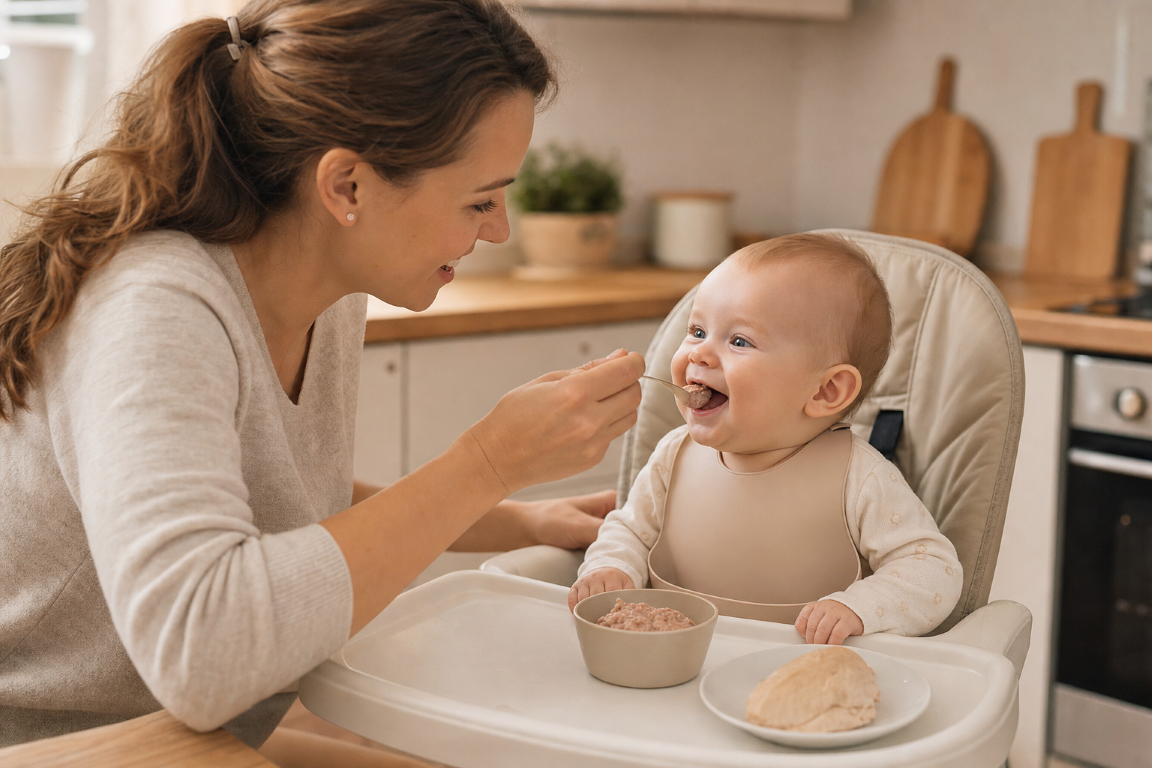
In short: At 7-8 months, the baby's diet is supplemented with meat, egg yolk, gluten-containing cereals and the first fermented milk products. The number of "complementary" feedings increases to two per day, the volume is up to 100-150 ml.
What changes by 7 months
By this age, the baby has already become familiar with several vegetables and, possibly, gluten-free cereals. The digestive system is more mature, the chewing reflex is developing (even without teeth – the gums are active), and the baby is ready for more complex tastes and slightly altered textures. Read about the initial stage of complementary foods in the article "Complementary foods at 6 months".
Important: the expansion of the diet is always gradual. You don't need to introduce several new products at once — stick to the "one product — 3-5 days" rule. If you have just started complementary foods later (for example, at 7 months), follow the logic of the initial stage, and do not "catch up" with the volumes of your peers. About the sequence of introducing products - in the article "How to start complementary foods: first products by month".
Meat: the most important new product
Meat is one of the priorities at 7-8 months. It contains heme iron (absorbed much better than iron from plant sources), zinc, protein and B vitamins. Boil the meat until fully cooked, grind in a blender to a homogeneous consistency and add to the vegetable puree.
The first servings are 5-10 g (1-2 teaspoons). By 9 months - up to 30-40 g per day. For more information about the introduction of meat, see the article "Meat in complementary foods: when and how to introduce it".
Egg yolk
The yolk of a chicken (or quail) egg is introduced from 7-8 months: it is rich in fat-soluble vitamins (A, D, E, K), lecithin and iron. Start with 1/4 yolk of a well-boiled hard-boiled egg, mashed and mixed with mashed potatoes or porridge. Egg white is a potential allergen, it is injected no earlier than 9-12 months. About the safe introduction of allergens - in the article "Allergy to complementary foods".
Expansion of cereals: add gluten
If until now they gave only gluten-free porridge (rice, buckwheat, corn), now is the right time for oatmeal or wheat porridge. ESPGHAN recommends introducing gluten no later than 7 months - with continued breastfeeding, this reduces the risk of celiac disease. Start with a small amount, observing the interval of 3-5 days.
The first fermented milk products
From 8 months, you can introduce baby cottage cheese and baby kefir. These are sources of calcium, protein and beneficial lactobacilli. Important: we are talking about specialized children's products (with less protein and acidity), and not about adult kefir and cottage cheese from the store. Whole cow's milk as the main drink - no earlier than 12 months. The volume of cottage cheese is starting from 10-20 g, kefir from 10-20 ml.
Food texture at 7-8 months
Gradually move from a completely homogeneous puree to a puree with soft small pieces. This stimulates the chewing reflex and the motor skills of the tongue. If the baby chokes on even soft pieces, do not force: return to a homogeneous texture for another 1-2 weeks. Many children at this age begin to take soft food with their hands (soft pieces of banana, boiled potatoes, boiled carrots) - this is an element of self-feeding and develops fine motor skills well.
Approximate diet at 8 months
- 1st feeding: breast/formula.
- 2nd feeding (breakfast): porridge 100-120 ml + 1/2 yolk.
- 3rd feeding (lunch): vegetable puree 120-150 ml + meat puree 20-30 g.
- 4th feeding: breast / formula + fruit puree 50-60 g.
- 5th feeding (dinner): breast/formula.
This is an indicative scheme. The real regime adapts to the rhythm of a particular child. About the combination of complementary foods and breastfeeding - in a separate article.
When to see a doctor
- After the introduction of yolk or meat, a rash or stool disorder appeared.
- The child refuses all types of food or has sharply reduced his appetite.
- The stool contains blood or mucus.
- The baby does not gain weight.
Frequently Asked Questions
Is it necessary to give vitamin D when expanding complementary foods?
Yes, preventive intake of vitamin D is recommended for all children in the first year of life, regardless of the type of feeding and the beginning of complementary foods. Check the dose and form of the drug with your pediatrician.
Can soup be given at 7-8 months?
Vegetable puree soup on water (without frying, spices and salt) – yes, this is a lunch option. Meat or fish broth is undesirable before 1-1.5 years: the high content of extractives burdens the digestive system.
Conclusion
At 7-8 months, the baby's diet becomes truly diverse: vegetables, cereals, meat, yolk, fermented milk products. This is an important step to cover the need for iron, zinc and calcium. The main principle remains the same: gradualness, observation of the reaction and orientation towards the child, and not on a strict scheme.
Bibliography
- ESPGHAN Committee on Nutrition. Complementary Feeding: A Position Paper. J Pediatr Gastroenterol Nutr. 2017; 64(1):119–132.
- National program for optimizing the feeding of children in the first year of life in the Russian Federation. Union of Pediatricians of Russia, 2019.
- Fewtrell M, et al. Optimal duration of exclusive breastfeeding. J Pediatr Gastroenterol Nutr. 2017; 64(1):119–132.
- Domellof M, et al. Iron Requirements of Infants and Toddlers. J Pediatr Gastroenterol Nutr. 2014; 58(1):119–129.
- WHO. Guiding principles for complementary feeding of the breastfed child. PAHO/WHO, 2003.
This material is for informational purposes only and does not constitute medical advice and is not a substitute for medical advice. An individual complementary feeding plan is drawn up by a pediatrician, taking into account the characteristics of your child.