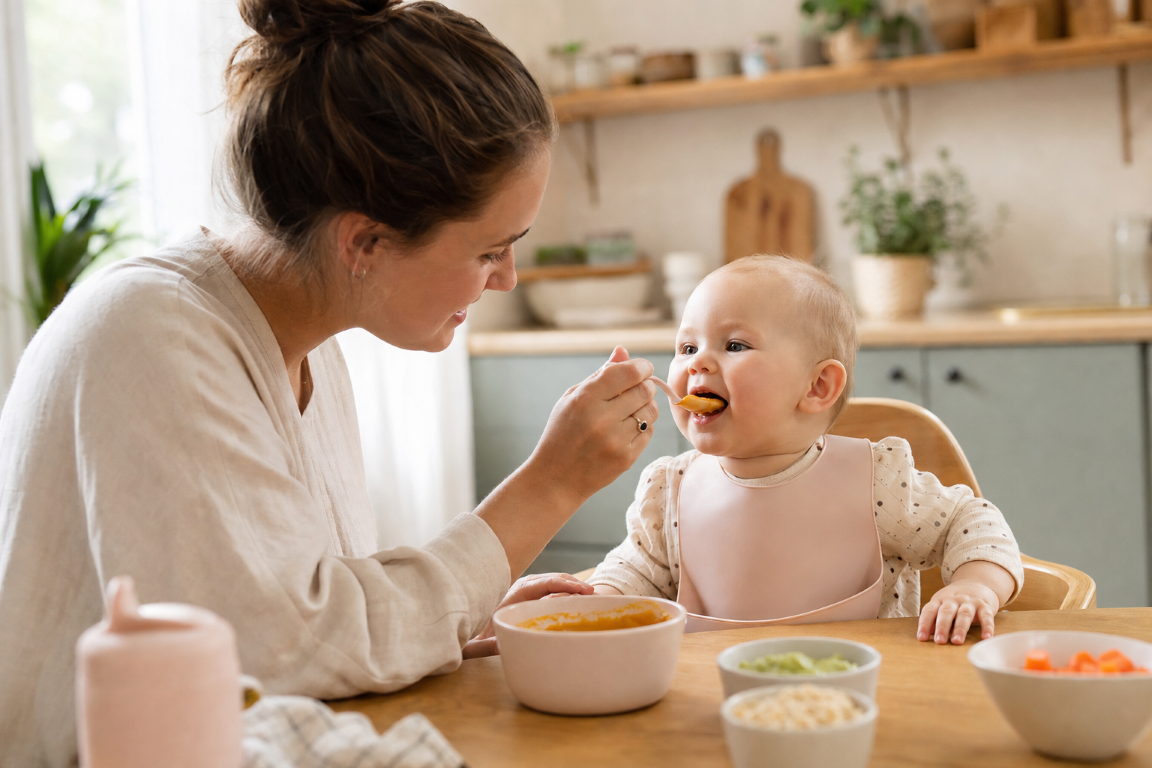
In short: Complementary foods while breastfeeding do not cancel the breast - it complements it. Breast milk remains the main source of nutrition for up to 12 months and an important supplement for up to 2 years and beyond. Give the breast before and after meals: this supports lactation and does not cause stress to the baby.
Why introduce complementary foods if there is breast milk?
Breast milk is an ideal food for the first 6 months of life. But starting from about this age, the child's needs for energy, iron, zinc and a number of other nutrients begin to exceed what milk alone can provide. At the same time, digestive maturity is formed and oral motor skills are developed - the child is ready to chew, swallow more complex food. In this sense, complementary foods are not a competitor to the breast, but its ally.
The WHO recommends continuing breastfeeding along with complementary foods for up to 2 years or more - if the mother and child wish. This is important: complementary foods do not mean the end of breastfeeding. If you are thinking about weaning, it is worth considering the age of the baby and his individual needs.
How to build a feeding regimen when introducing complementary foods
The most common anxiety of nursing mothers is: "Will complementary foods reduce lactation?" The key rule: do not replace breastfeeding with food, but add complementary foods as a separate "meal".
The classic scheme looks like this:
- Offer the breast - feed the baby halfway or until satisfied.
- Give complementary foods - a small amount of mashed potatoes or porridge.
- Breast again – if the baby wants, finish breastfeeding.
This order preserves the demand for milk (and therefore lactation) and helps the baby not to perceive complementary foods as a breast replacement. As the volume of complementary foods increases, the child will begin to take less milk on his own - gradually, without stress.
How many breastfeedings per day with the introduction of complementary foods?
At 6 months, complementary foods take up only one meal a day - the remaining 7-12 attachments (different for different children) remain breastfeeding. By 9-10 months, complementary foods can consist of 2-3 meals, by the age of 3. But the number of breastfeedings decreases gradually: the baby regulates how much milk he needs.
There is no norm "how many times a day to breastfeed with complementary foods". Focus on the child, not on the tables. If the baby is active, gains weight well and wets 6+ diapers a day, everything is fine.
What to do if the child refuses complementary foods for the sake of breastfeeding
This is normal and very common. Breasts are not just food, but also comfort, intimacy, a way to calm down. Do not force complementary foods - this creates negative associations with food. Try to offer complementary foods at a time when the baby is cheerful and slightly hungry (but not in severe hunger - otherwise he will demand breasts). You can try self-complementary foods (BLW) - some children are more willing to explore food with their hands, rather than with a spoon. If the refusal is protracted, discuss this with a pediatrician.
Night feedings and complementary foods
The introduction of complementary foods does not guarantee that the child will start sleeping all night. Night awakenings at 6-12 months are the norm from the point of view of sleep neurobiology, and the calorie content of complementary foods rarely plays a role here. Read more about the causes of night awakenings in the article "Why a child often wakes up at night". Continue to feed at night while the baby asks: this supports lactation and satisfies his need for intimacy.
Is it necessary to express when introducing complementary foods?
No, if you feed on demand and lactation is established. A decrease in the volume of attachments during the introduction of complementary foods can lead to a slight decrease in milk production - this is a normal adaptation. If you notice a significant drop in lactation or an "empty breast" feeling, talk to a lactation consultant.
Complementary foods for mixed feeding
If the child receives both breast and formula, the timing of the introduction of complementary foods is the same - about 6 months, if there are signs of readiness. The feeding scheme is built similarly: complementary foods are a separate technique, and not a replacement for breast or formula.
If you're just starting to understand the topic, check out our article on how to establish breastfeeding from the very beginning — it explains the basic principles that will help with the introduction of complementary foods.
When to see a doctor
- The baby abruptly stopped gaining weight after the introduction of complementary foods.
- Lactation decreased markedly, and the child became restless after feedings.
- The child completely refuses to breastfeed after the start of complementary foods.
- There are signs of an allergic reaction to the new product.
Frequently Asked Questions
Is it necessary to give water if the baby is breastfed?
Up to 6 months with exclusive breastfeeding – no. With the introduction of complementary foods, a small amount of water (a few sips) when eating is permissible and helps to form the skill of drinking from a cup.
Will the milk decrease if the baby starts eating?
Gradually, yes, this is a natural process. But with frequent attachments and feeding on demand, milk is stored in sufficient volume for a long time. There is no abrupt disappearance of milk from complementary foods.
Conclusion
Complementary foods and breastfeeding are not a contradiction, but a partnership. Breasts remain the main food for up to one year, and complementary foods expand the baby's eating experience. The main principle is to add, not replace. Keep an eye on the child, not the rigid schemes, and your tandem will work gently and comfortably for both.
Bibliography
- WHO. Infant and young child feeding: Model Chapter for textbooks for medical students and allied health professionals. WHO Press, 2009.
- ESPGHAN Committee on Nutrition. Complementary Feeding: A Position Paper. J Pediatr Gastroenterol Nutr. 2017; 64(1):119–132.
- AAP Policy Statement. Breastfeeding and the Use of Human Milk. Pediatrics. 2012; 129(3):e827–e841.
- Victora CG, et al. Breastfeeding in the 21st century: epidemiology, mechanisms, and lifelong effect. Lancet. 2016; 387(10017):475–490.
- National program for optimizing the feeding of children in the first year of life in the Russian Federation. Union of Pediatricians of Russia, 2019.
This material is for informational purposes only and does not constitute medical advice and is not a substitute for medical advice. If you are concerned about lactation, weight gain or his reaction to complementary foods, contact your pediatrician or lactation consultant.