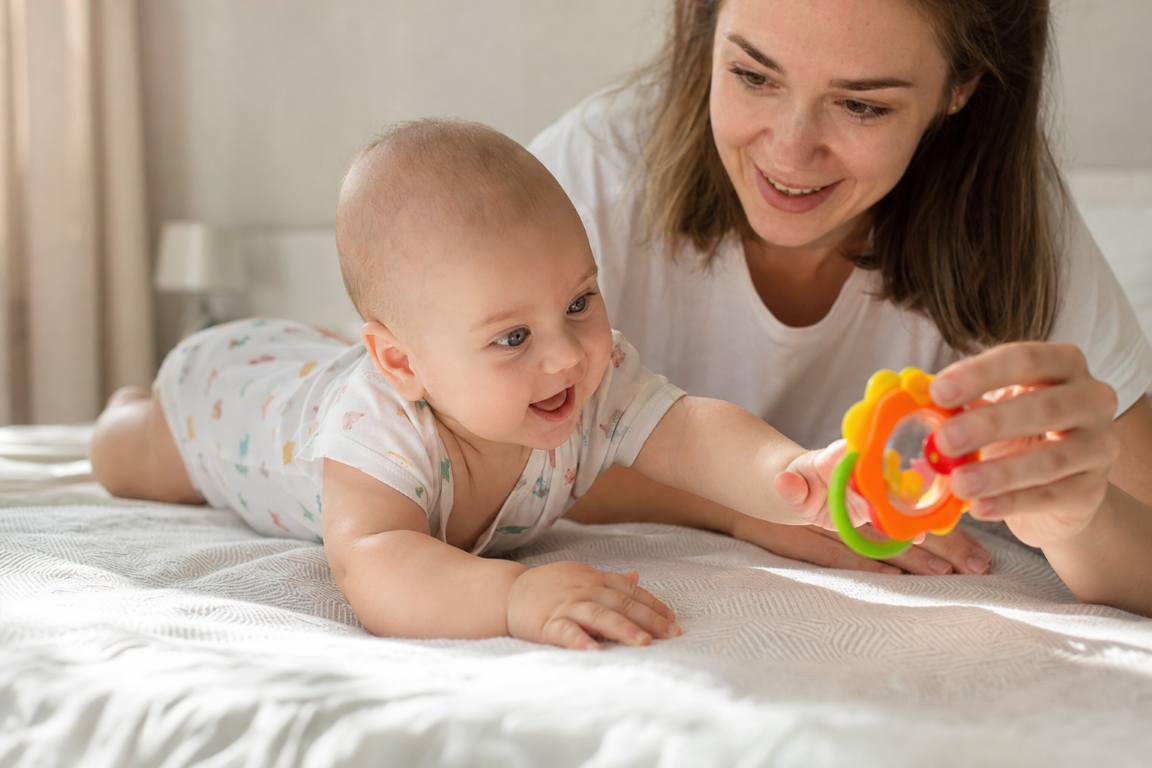
In short: In the first three months, the main developmental "activity" is live communication, contact and response to the needs of the child. Tummy time, talking, singing, and touch touch – nothing else is needed.
What to expect from a baby at 0-3 months
In the first months, the child is busy with the most important work: getting used to life outside the womb, adjusting sleep, digestion and temperature regulation. His nervous system is immature, the periods of wakefulness are short - 45-90 minutes in the first weeks.
Developmental "classes" at this age should not be formal. It's just attentive, empathetic care: feeding on demand, responding to crying, body contact, talking. This is what forms the basis for all further development.
Read more about what the baby can do in each specific month in the large article Child Development by Month.
Tummy time: the most important exercise
Tummy time strengthens the muscles of the neck, shoulder girdle and back - the foundation of all further motor skills. The AAP recommends starting in the first days of life and gradually building up to 30 minutes per day by 3 months.
- Start with 1 to 2 minutes a few times a day after waking up and changing your diaper
- Place on a hard surface: the floor on the rug is safer than the sofa
- Lie next to or opposite – your face motivates the baby to raise his head
- If the baby cries right away, try it on your chest or stomach – this is also tummy time
- Never leave your baby on his tummy unattended or put him to sleep on his stomach
Regular tummy time creates the basis for motor development — flipping, crawling, and walking.
Eye contact and the face of an adult
A newborn sees best at a distance of 25-30 cm and focuses on contrasting objects. The human face is the most interesting "object" for a baby. Black and white patterns are also a good eye-catcher.
What to do:
- Keep your baby facing you when feeding and changing
- Change your facial expression – the baby is already trying to copy it at 2-3 months
- Stick out your tongue slowly – many children try to repeat this movement
- Place black and white cards or a mobile at a distance of 25-30 cm from the child's eyes
Talking, singing, sounds
The baby's brain "tunes" to the language from the first weeks. Every word you say is a contribution to your future speech. There is no need to say anything special: comment on your actions, sing lullabies, name objects.
- Speak in "infant-directed speech" – a raised tone, a slow pace, clear articulation – this is normal and useful for learning speech
- Pause and "wait for an answer" – form the skill of dialogue
- Sing the same simple songs – repetition helps the nervous system
- Play with intonation: surprise, joy, question
By 3 months, the child begins to coo in response - this is the beginning of speech development.
Touch & Massage
The skin is the largest sense organ. Light massage, stroking and tactile games stimulate the nervous system and help the child master his own body.
- Gently stroke your hands and feet while changing
- Put your finger in the palm of your child's hand and he will instinctively squeeze it
- Let's touch fabrics of different textures: soft, smooth, a little rough
- Detailed techniques are in the article massage for babies
Hearing: Music and Silence
At 0-3 months, the auditory system is actively developing. The child already distinguishes between the mother's voice and an unfamiliar voice, reacts to rhythm and tonality.
- Turn on soothing music while awake - classics, natural sounds, lullabies
- You don't need constant background noise: the child also needs silence to process information
- Rattles and soft rattles are the first "sound toys"
- Shake the rattle to the side of the baby's head – he should turn his head to the sound (by 3-4 months)
Walks and a change of scenery
Fresh air, a change of scenery and sensory impressions from a walk are a full-fledged "developmental activity". Name what you see: trees, birds, cars. This works even with a newborn.
What not to need at this age
- Tablets and TV – AAP does not recommend screens for children under 18 months of age (except for video calls)
- "Educational" DVDs and videos do not improve the development of a child under 2 years old
- Forced scheduled classes – follow your child, not someone else's plan
- Special "courses for babies" - basic development is provided by loving parents, not paid courses
When to see a doctor
- At 2 months, there is no social smile and eye contact
- Does not respond to sounds and voice
- At 3 months, he does not keep his head on his stomach even for a second
- He is very sluggish, does not show any interest in his surroundings
Frequently Asked Questions
How much time to devote to classes?
At 0-3 months, the periods of wakefulness are short - 30-60 minutes. Every moment of wakefulness with your participation is already an "occupation". There is no need to set aside special time - this happens during feeding, changing a diaper, bathing.
Do I need a special educational mat?
A regular clean rug or blanket on the floor is suitable for tummy time. Arches with hanging toys are convenient for independent study, but are not mandatory. A colorful expensive "developmental" does not give advantages over a simple mat next to you.
Conclusion
At 0-3 months, the child does not need special classes and expensive toys. He needs you: your voice, your face, your touch, and your response. Tummy time, talking, and routine care are the best development for this age.
Bibliography
- American Academy of Pediatrics. (2022). Back to Sleep, Tummy to Play. HealthyChildren.org.
- Kuhl P.K. (2010). Brain mechanisms in early language acquisition. Neuron, 67(5), 713–727.
- Zero to Three. (2023). Brain Development in Infants. zerotothree.org.
- Pin T. et al. (2007). A review of the effects of sleep position, play position, and equipment use on motor development. Dev Med Child Neurol, 49(11), 858–867.
- Khomskaya, E.D. (2002). Neuropsychology. Moscow: Piter.
This material is for informational purposes only and does not constitute medical advice and is not a substitute for medical advice. If you are concerned about your child's development, consult your pediatrician or pediatric neurologist.