In short: According to the WHO, the norm for starting walking is from 9 to 15 months. A child who started at 15 months is just as normal as someone who started at 10. There is no need to rush walking - it will come by itself when the brain and muscles are ready.
Walking norms: what the WHO says
In 2006, the WHO conducted a large-scale multicenter study (WHO Multicentre Growth Reference Study) with the participation of children from six countries. Conclusion: independent walking begins in the range from 9 to 15 months, while the vast majority of children go by 14-15 months.
AAP considers up to 18 months normal if there are no other signs of developmental delay. In the absence of independent walking, a planned consultation is recommended at 15 months, and a mandatory consultation is recommended at 18 months.
Average age of first steps: 11–13 months. But "average" does not mean "correct" – sooner or later within the normal range, equally good.
Stages of mastering walking
Walking is the result of a long preparatory chain. Each stage is necessary:
- Flip and tummy time (3-6 months) – strengthening the muscles necessary for an upright position
- Sitting (6-9 months) - core muscles and balance
- Crawling (7-10 months) – coordination, spatial thinking
- Pull-up to standing (8-10 months) - strengthening the legs
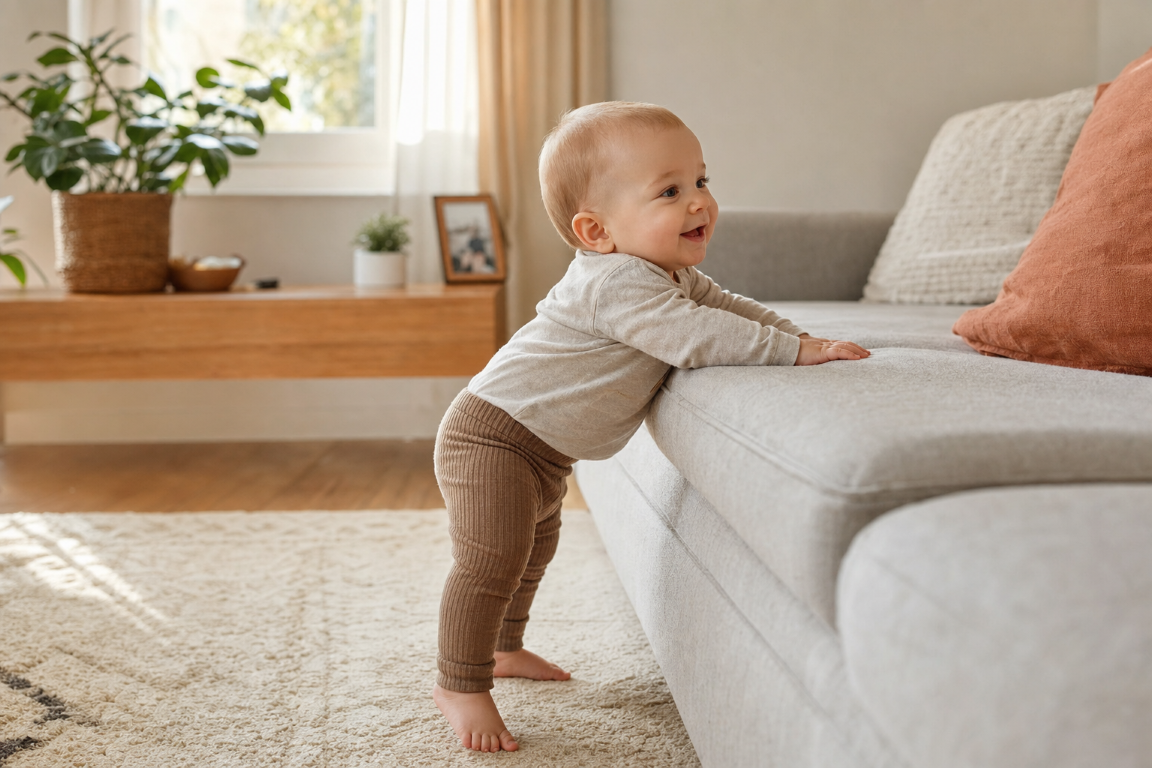
- "Cruising" (9-12 months) – walking along the furniture, balance
- Standing without support (10-13 months) – a few seconds
- First steps (9-15 months) – independent walking
Read more about motor development at each stage in a separate article.
What does normal walking look like at the beginning
The first steps to look "wrong" are normal:
- Legs wide apart for balance
- Arms are raised up or to the sides ("carry the tray")
- Frequent falls - up to several times per minute
- Walking on toes or heels is normal in the first weeks
- Uneven surface causes difficulties
Within 3-6 months after the start of walking, all these features are smoothed out. If walking on toes persists after 2 years, it is worth mentioning to the pediatrician.
How to help: environment and motivation
- Floor space free of obstacles and dangers
- A low sofa or a stable table against the wall for "cruising"
- A pusher (not a walker!) is a safe support for the first steps
- Call the child to you from a distance of 1-2 steps, stretch out your hands
- Motivating object (favorite toy) at a short distance
- At home - barefoot. The foot "feels" the floor better, the muscles work more correctly
Shoes: when and what kind
You don't need shoes before you start walking. After starting to walk, wear the first shoes for walking on the street.
What is important in the first shoe:
- Flexible sole – the foot should "work", not be fixed
- Wide toe cap – doesn't squeeze your fingers
- Solid heel - fixes the heel
- Light weight – heavy shoes are tiring
- The foot should move freely, the foot should not "float" inside
Arch supports and orthopedic shoes without a doctor's prescription are not needed. Flat feet up to 3-4 years old is a physiological norm.
What not to do
- Walkers: AAP does not recommend. Create a risk of injury, do not speed up walking and can delay it
- Holding your hand constantly: the child must learn balance on his own – falls are necessary for learning
- Compare with other children: the spread of the norm is huge
When to see a doctor
- Does not walk on his own at 15 months – scheduled consultation
- Does not go at 18 months - mandatory consultation with a neurologist
- Pronounced asymmetry: much worse use of one leg
- Walking on toes persists after 2 years
- The child began to walk, then stopped
- Very high or very low muscle tone
For more information about warning signs, see the article Warning Signs in Development. For a general overview of development, see the article development by month.
Frequently Asked Questions
Is it normal for a child to stand only on tiptoe?
In the first 2-3 months after the start of walking, it is normal. The child experiments with the position of the body. If socks are retained as the only way to walk for longer than 3-4 months or for a child already 2 years old, discuss with a pediatrician or neurologist.
Does a night's sleep affect when a baby walks?
There is no direct connection, but quality sleep is important for the maturation of the nervous system as a whole. During periods of mastering new skills, including walking, sleep is often disturbed — for more details, see the article Sleep Regression.
Conclusion
Walking will come in due time. Create a safe environment, give freedom of movement and do not compare the child with peers. Routine checkups and monitoring your overall development are the best way to make sure everything is going well.
Bibliography
- WHO. (2006). WHO Multicentre Growth Reference Study Group. WHO Motor Development Study. Bulletin of the World Health Organization, 84(7), 581–590.
- American Academy of Pediatrics. (2023). Developmental Milestones: 12–18 Months. HealthyChildren.org.
- Adolph K.E. et al. (2012). How do you learn to walk? Thousands of steps and dozens of falls per day. Psychological Science, 23(11), 1387–1394.
- Hallemans A. et al. (2006). Low back loading in children during walking. Gait & Posture, 23(3), 339–347.
- AAP. (2023). Choosing Safe Baby Products: Infant Walkers. HealthyChildren.org.
This material is for informational purposes only and does not constitute medical advice and is not a substitute for medical advice. If you are concerned about your child's motor development, see your pediatrician or pediatric neurologist.