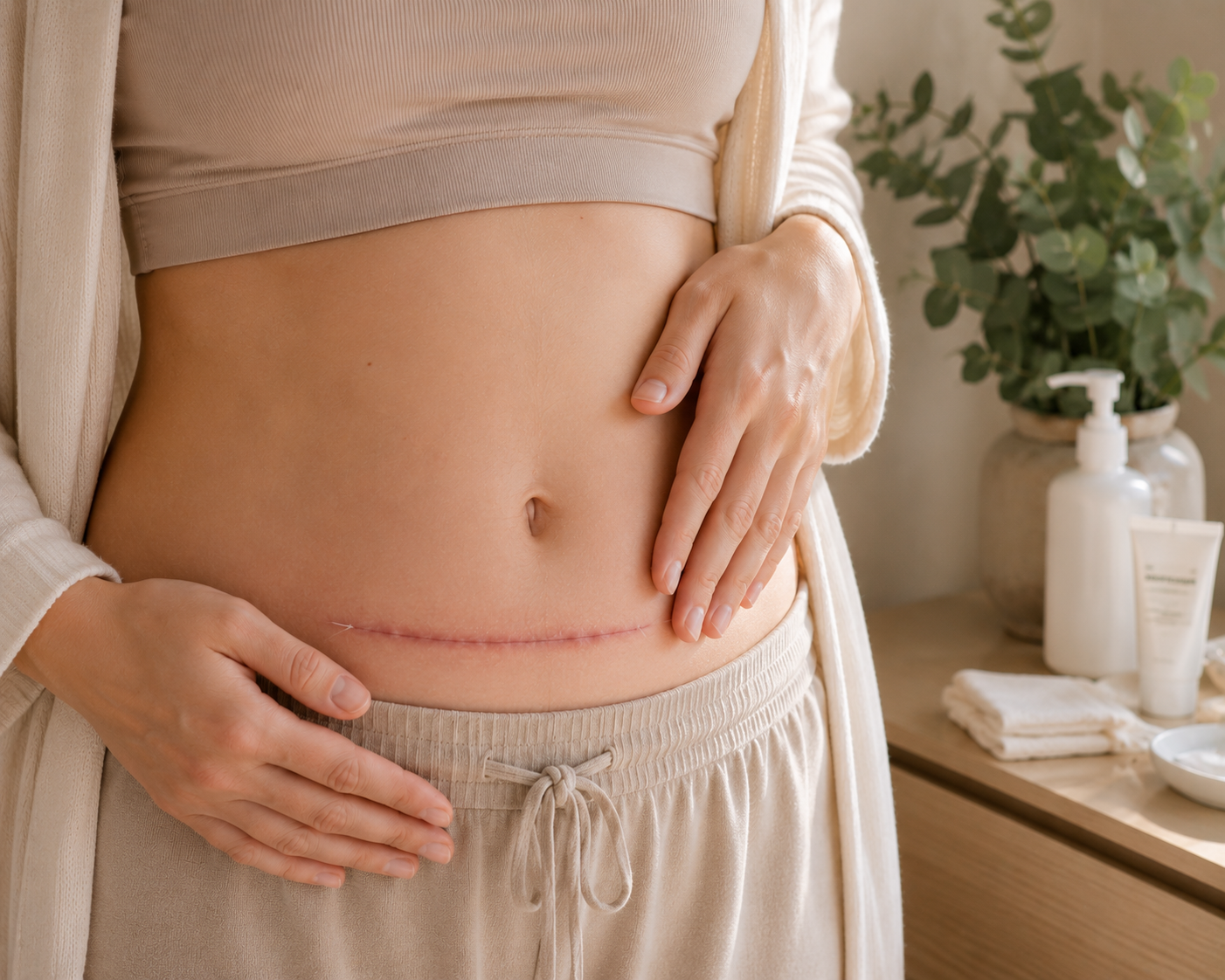
In short: sutures after childbirth - on the perineum or after a cesarean - usually heal in 2-6 weeks. Cleanliness, gentle washing and refusal of heavy loads are the main rules of care. Pain, odor or suture dehiscence is a reason to urgently consult a doctor.
Types of sutures after childbirth
After childbirth, there are two types of sutures:
- Sutures on the perineum - after tears or episiotomy. They are applied with self-absorbable sutures (usually after 2-4 weeks, the sutures dissolve themselves).
- Sutures on the abdomen - after a cesarean section. The outer suture is staples or non-absorbable sutures, which are removed after 7-10 days. The internal sutures dissolve on their own.
Care for perineal sutures
Hygiene:
- Wash your crotch with warm water after each visit to the toilet (from front to back).
- Blot (do not rub!) with a clean towel or disposable tissues.
- Change pads every 3-4 hours – a humid environment slows down healing.
- Do not use soap with fragrances and wet wipes with alcohol - they irritate fabrics.
Pain reduction:
- Cold compress (ice in a towel) for 20 minutes several times a day for the first 24 to 48 hours.
- Painkillers (ibuprofen, paracetamol) – as prescribed by a doctor, compatible with breastfeeding.
- A warm bath (sitz bath without additives) from day 3-4 – relieves pain and reduces swelling.
- Ring cushion for sitting in the first days.
Care for the suture after cesarean
In the maternity hospital: the nurse changes the bandage. For the first 24-48 hours, the suture is closed with a sterile bandage.
After discharge:
- Wash the seam in the shower with warm water and mild soap. Gently pat dry.
- Do not scrub the seam with a sponge or use stiff towels.
- Do not wet the seam in the bath and pool for 6-8 weeks.
- Wear loose cotton underwear with a high waist or special post-operative underwear so that the elastic band does not press on the seam.
- Do not apply creams and oils to the seam without the recommendation of a doctor - this can clog the pores and provoke an infection.
Healing time
- Stitches on the perineum: acute pain usually disappears in 2-3 weeks. The threads are absorbed in 2-4 weeks. Complete tissue healing is 6-12 weeks.
- Cesarean suture: the skin heals in 2-3 weeks. Internal tissues – 8-12 weeks. The rumen continues to "mature" (pale and soften) up to 12-18 months.
What is normal during healing
- Itching in the suture area is a sign of active healing.
- Slight numbness around the suture (damage to small nerves).
- Slight swelling and sealing of the suture.
- Threads that "stick out" and gradually disappear (dissolve).
Warning signs
See a doctor if:
- Increasing, not decreasing, pain in the suture area after 3-4 days.
- Redness, swelling, discharge of fluid (especially with an odor) from the suture.
- The edges of the suture diverge (dehiscence - seam divergence).
- The temperature is above 38 °C.
- Feeling that "something has fallen out" of the vagina (maybe a thread or a small hematoma).
Scar massage after cesarean
6-8 weeks after the operation, when the suture is completely closed, you can start massaging the scar. This prevents the formation of adhesions and reduces sensitivity:
- Lubricate the tripe with neutral oil (such as rose oil or regular olive oil).
- Massage the scar in a gentle circular motion for 5-10 minutes a day.
- Gradually add lateral and longitudinal movements along the scar.
If you wish, consult a physiotherapist specifically for rehabilitation after a cesarean section.
When to see a doctor
Contact a doctor or call an ambulance urgently if:
- an unpleasant odorous fluid or pus is released from the suture after a cesarean section;
- the edges of the suture diverge by more than 0.5 cm;
- The stitches on your perineum hurt so much that you can't sit or walk, and painkillers don't help.
- There are signs of gas or fecal incontinence (a possible sign of sphincter failure).
Frequently Asked Questions
Do I need to treat the seams with brilliant green or iodine?
No. Modern recommendations do not prescribe the treatment of sutures with antiseptics in the norm - cleanliness is enough. Antiseptics can slow tissue healing.
Will the threads come out on their own after childbirth?
Absorbable sutures dissolve on their own after 2-4 weeks. Sometimes part of the thread comes out in the form of a small knot - this is normal. Non-absorbable sutures after cesarean are removed by a doctor.
When can I start Kegel exercises?
As soon as pain allows, usually from the first day after childbirth. They will not harm the sutures and, on the contrary, accelerate blood circulation in the tissues and healing.
Conclusion
Taking care of the stitches after childbirth is simple but important. The main thing is cleanliness, minimal load and attention to change. The pain should decrease, not increase. If you have any doubts, do not postpone a visit to the doctor – early treatment of complications is always better.
Bibliography
- NICE guideline CG37. Routine postnatal care of women and their babies. 2006 (updated 2015). https://www.who.int/publications/i/item/9789241506649
- Elharmeel SM et al. Surgical repair of spontaneous perineal tears during childbirth. Cochrane Database. 2011. https://pubmed.ncbi.nlm.nih.gov/21975762/
- ACOG Practice Bulletin No. 198. Prevention and Management of Obstetric Lacerations at Vaginal Delivery. 2018.
- Ministry of Health of the Russian Federation. Clinical guidelines: Postpartum period. 2022. https://cr.minzdrav.gov.ru/
- Bick D et al. Postnatal care: evidence and guidelines for management. Churchill Livingstone; 2002.
This material is for informational purposes only and does not constitute medical advice and is not a substitute for medical advice. If a child's sleep is accompanied by alarming symptoms, a pronounced deterioration in health, problems with breathing, feeding or weight gain, it is necessary to consult a qualified medical specialist as soon as possible, and not rely only on information from the Internet.