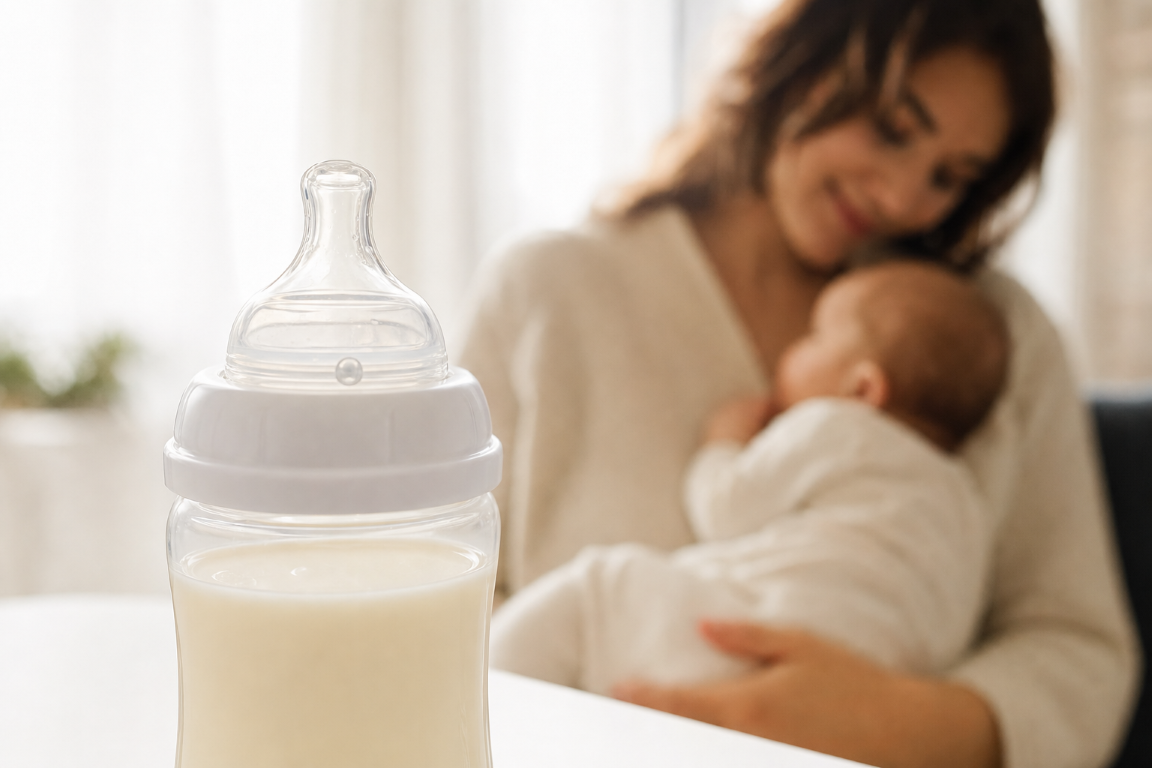
In short: Supplemental feeding from a bottle with the correct technique (pace-feeding) and late introduction (not earlier than 3-4 weeks) has a minimal effect on breastfeeding. The main thing is to maintain breast stimulation by feeding or pumping.
When you need supplemental feeding
Supplemental feeding is additional food (formula or expressed breast milk) in addition to what the child receives during breastfeeding. It is recommended when:
- The child did not regain birth weight by day 14
- Weight gain of less than 150 g per week
- Less than 6 wet diapers per day
- Signs of dehydration (dark urine, sunken fontanelle, lethargy)
- Mother separated from her child (going to work, hospitalization)
The amount of supplemental feeding and its need is determined by the pediatrician - not by the parents themselves "by eye". Read more about the signs of sufficient nutrition in the article on how to understand that a child is full.
When to insert the bottle
If breastfeeding is established, it is recommended to introduce a bottle no earlier than 3-4 weeks. Insertion too early (the first days of life) significantly increases the risk of "nipple confusion" and breast rejection.
If medical necessity requires additional feeding immediately, consider alternatives to the bottle: spoon, syringe (without needle), soft non-spill cup. These are safer ways for breastfeeding.
How to choose a bottle for supplemental feeding
- Slow flow is the most important parameter. Milk should flow out slowly so that the baby makes an effort similar to sucking at the breast.
- Wide base of the nipple – the baby wraps around the wide nipple with his mouth in the same way as the areola. Reduces confusion.
- Rounded, soft nipple – imitates the shape of the breast.
- Ventilation valve – reduces air swallowing.
Pace-fed feeding technique
Paced feeding is a bottle feeding method that mimics the rhythm of breastfeeding. The main goal is to teach the child to control the speed of eating and not get used to a fast flow.
- Hold the bottle almost horizontally (not at a downward angle)
- Wait until the baby "catches" the pacifier himself - do not force it
- About every 20-30 seconds, move the bottle to a horizontal position, pausing for 5-10 seconds
- Let the child signal satiety – do not "eat" the bottle to the end
- Alternate sides - offer the bottle on one side, then on the other
Important: With pacefeeding, feeding takes about the same time as breastfeeding - about 15-20 minutes. This is normal and correct.
How to maintain lactation during supplemental feeding
Every time the baby receives supplemental feeding from a bottle instead of breastfeeding, the breast is not stimulated. This reduces milk production. To avoid this:
- Always give the breast before supplementing
- If the baby does not breastfeed, express instead of or immediately after bottle feeding
- Maintain nighttime latches
- Offer breasts regularly between bottle feedings
Read more about mixed feeding and maintaining lactation with it.
What to do if a child refuses a bottle
A child who is used to the breast may refuse a bottle. Tips:
- Give a bottle at the moment when the child is not very hungry (does not scream from hunger)
- Let the bottle be given not by the mother, but by another person - in the absence of the mother
- Try different nipple shapes
- Warm the nipple to body temperature
When to see a doctor
- Despite supplemental feeding, the child does not gain enough weight
- After the bottle was inserted, the baby began to refuse the breast
- The child chokes, coughs when feeding from a bottle
Frequently Asked Questions
Can I supplement with expressed milk instead of formula?
Yes, if you have a sufficient supply of expressed milk, this is the preferred option. Expressed breast milk retains all the benefits of breastfeeding and does not pose a risk of allergies.
Conclusion
Bottle feeding and successful breastfeeding are compatible things with the right approach. Use paced feeding, choose a slow flow, maintain breast stimulation - and lactation will remain at the desired level.
Bibliography
- ABM Clinical Protocol #3: Supplementary Feedings in the Healthy Term Breastfed Neonate. Breastfeeding Medicine. 2017.
- Bergman NJ, et al. Randomized controlled trial of skin-to-skin contact from birth versus conventional incubator for physiological stabilization in preterm infants. Acta Paediatrica. 2004.
- Howard CR, et al. Randomized clinical trial of pacifier use and bottle-feeding. Pediatrics. 2003.
- Flaherman VJ, et al. Early limited formula in breastfeeding infants. Pediatrics. 2013.
- National program for optimizing the feeding of children in the first year of life in the Russian Federation. Union of Pediatricians of Russia, 2019.
This material is for informational purposes only and does not constitute medical advice and is not a substitute for medical advice. If a child has alarming symptoms, a pronounced deterioration in health, problems with breathing, feeding or weight gain, it is necessary to contact a qualified medical specialist as soon as possible, and not rely only on information from the Internet.