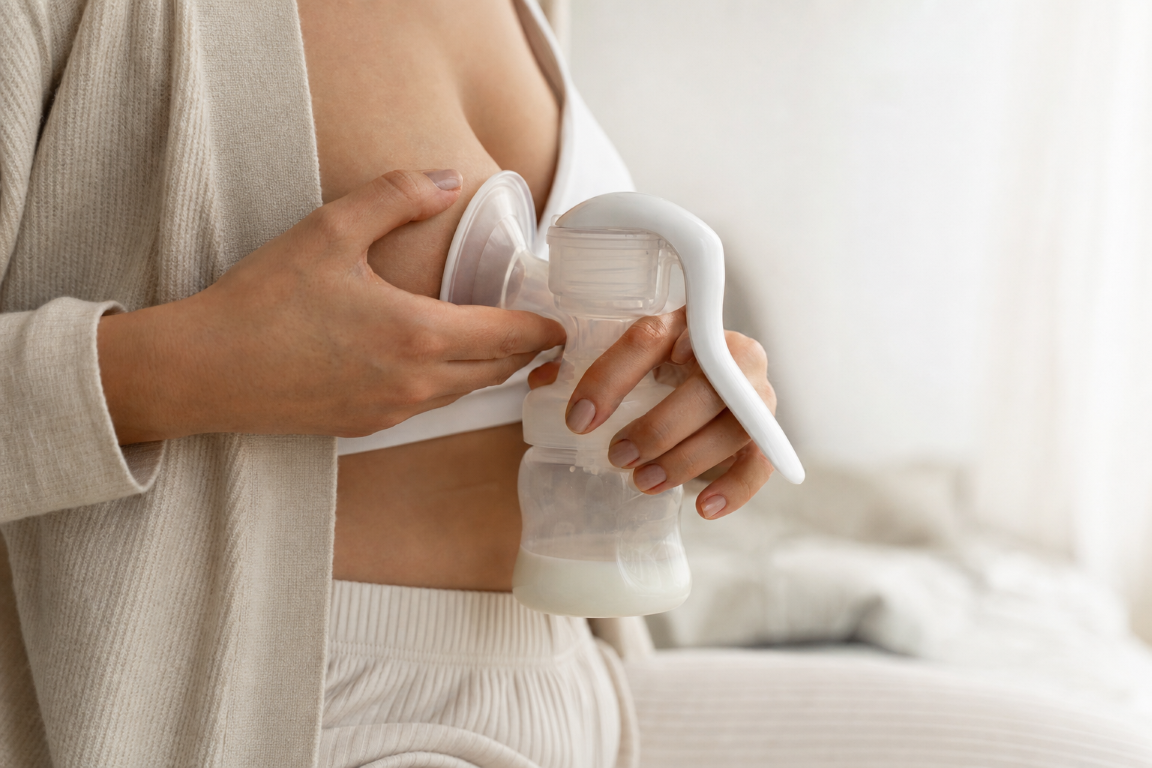
In short: Pumping is not necessary for all nursing mothers, but in some situations it is indispensable. The manual method is always available, the breast pump is more convenient with regular use. The main thing is the right technique and regularity.
When to express milk
Pumping may be needed in different situations:
- The baby cannot breastfeed (premature, in the intensive care unit)
- Breast engorgement, painful fullness
- Lactation crisis is an additional stimulation to increase production
- Mom goes back to work and wants to keep breastfeeding
- Creating a supply of milk for feeding in its absence
- Treatment of mastitis or lactostasis
- Taking medications by the mother that are incompatible with feeding (for the period of treatment - "express and pour out")
Manual pumping: step-by-step instructions
Manual pumping requires no equipment, is available at any time and allows you to feel your breasts precisely. Technique:
- Prepare – wash your hands, prepare a clean container
- Warmth and relaxation – a warm compress, warm shower or gentle massage before pumping helps trigger the milk release reflex
- Find the correct position – thumb on top of the areola, index finger below, about 2-3 cm from the base of the nipple
- Press back – to the chest (not to the nipple)
- Squeeze and roll forward – the thumb and index finger are squeezed and shifted to the nipple at the same time
- Repeat rhythmically – in a rhythm similar to sucking a baby. The first drops will appear in 1-2 minutes, the flow will increase
- Change the position of your fingers - move in a circle around the areola to empty different lobes
The Marmet technique is a classic manual pumping technique developed by Sidela Marmet. It is described in the materials of La Leche League and recommended by the WHO as a basic technique.
How to choose a breast pump
Breast pumps can be manual and electric, single and double (for both breasts at the same time). The choice depends on the frequency of use:
- Manual breast pump – suitable for occasional use (several times a week). Quiet, cheap, compact.
- Single electric - for daily use. Faster than manual, adjustable power.
- Dual electric pumping – for regular pumping, such as when you go to work. Twice as fast, supports milk production well.
- Wearable breast pump – worn inside the bra, hands free. It is convenient for mobile mothers, but the volume per session is usually less.
The size of the breast shield of the breast pump is critically important: the breast shield should fit the diameter of the nipple. The wrong size reduces effectiveness and can cause pain.
How to express with a hardware breast pump
- Start with the stimulation mode (quick light suction) - 2 minutes
- Go into pumping mode (slow, deep suctions)
- Power is as comfortable as possible, but not painful
- Duration: 10-15 minutes with one breast or 10 minutes with double pumping
- If the flow slows down, switch to the stimulation mode again (the second recoil reflex)
How to store expressed milk
The rules and terms of storage of expressed milk are described in detail in a separate article: storage of breast milk: rules and terms.
How much milk should be obtained
The volume of expressed milk is not an indicator of the sufficiency of lactation. When feeding, the baby extracts milk more efficiently than any breast pump. Many mothers with good lactation express a little - this is the norm.
Approximately: in the first weeks - 30-60 ml per session, by 4-6 weeks - 60-120 ml. Do not assess the sufficiency of the baby's nutrition by the volume of expressed milk.
How to increase volume when pumping
- Looking at a picture of your baby or hearing his voice while pumping
- Massage your breasts before and during pumping
- Warmth before pumping (warm shower, compress)
- Pump in a calm, stress-free environment
- Combine manual pumping with a breast pump (hands-on-pump)
When to see a doctor
- Pumping is painful despite the correct breast shield size
- A sharp decrease in the volume of expressed milk, if there was enough
- Signs of lactostasis (induration, redness, pain, fever)
Frequently Asked Questions
Can I pump immediately after feeding?
Yes, pumping immediately after feeding is an effective way to further stimulate lactation. There will be a little milk - this is normal, the child has already taken the bulk of it.
Does a breast pump need to be sterilized?
In the first 3 months and for premature babies – sterilization after each use is recommended. For healthy children over 3 months of age, thorough washing with soap and hot water or in the dishwasher is sufficient.
Conclusion
Pumping is a useful skill for a nursing mother. The right technique is the key to comfort and efficiency. The manual method is always available and does not require equipment, while the hardware method is more convenient for regular use. The main thing is not to assess the sufficiency of lactation by the volume of expressed milk.
Bibliography
- Marmet C. Manual expression of breast milk. Marmet technique. Lactation Institute; 1978.
- World Health Organization. Breastfeeding: expression and storage of breastmilk. 2009.
- Meier P, et al. Breast pump suction patterns that mimic the human infant during breastfeeding. J Perinatol. 2008.
- Morton J, et al. Combining hand techniques with electric pumping increases milk production in mothers of preterm infants. J Perinatol. 2009.
- National program for optimizing the feeding of children in the first year of life in the Russian Federation. Union of Pediatricians of Russia, 2019.
This material is for informational purposes only and does not constitute medical advice and is not a substitute for medical advice. If a child has alarming symptoms, a pronounced deterioration in health, problems with breathing, feeding or weight gain, it is necessary to contact a qualified medical specialist as soon as possible, and not rely only on information from the Internet.