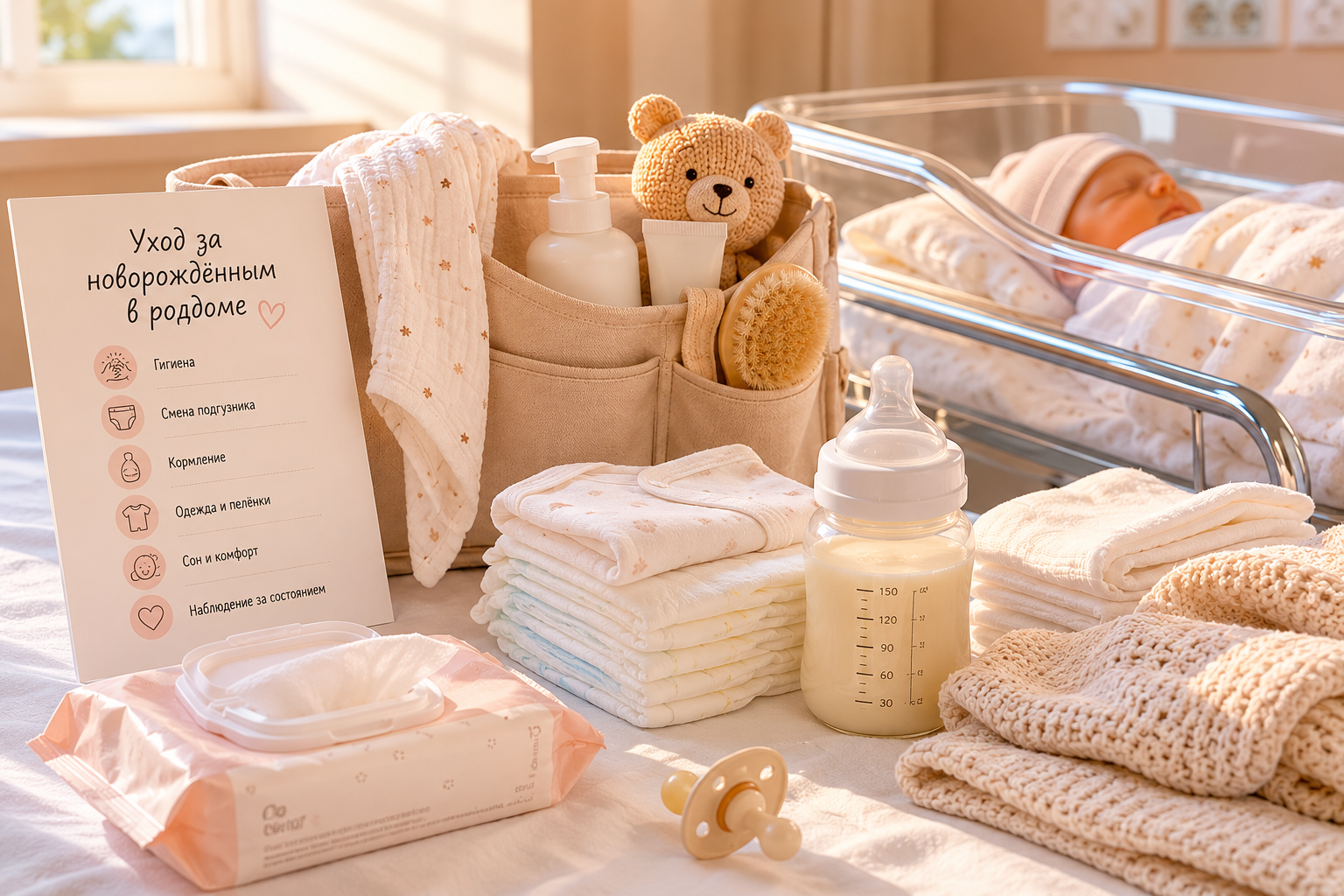
In short: in the maternity hospital, a neonatologist monitors the newborn, but the main care is in your hands. The first bath is postponed for 24 hours, the umbilical remnant dries up and falls off on its own, the breast is offered on demand.
First procedures after birth
Immediately after birth, the neonatologist assesses the baby's condition according to the Apgar scale, checks the patency of the airway and examines for the presence of congenital features. Then there is skin-to-skin contact with the mother.
Primary treatment: attachment to the breast, instillation of drops into the eyes (prevention of gonococcal conjunctivitis), administration of vitamin K (prevention of hemorrhagic disease of newborns). Read more about newborn screening in a separate article.
First bath
The WHO recommends postponing the first bath for at least 24 hours after birth. Causes:
- Vernix (primordial lubricant) protects the skin and retains heat - no need to wash it off immediately.
- The risk of hypothermia is reduced.
- The familiar smell of the mother is preserved for the baby - this is important for the first attachment.
In the maternity hospital, the first bath is usually carried out by a nurse - she will show how to hold the baby correctly. Water – 36-37 °C, without soap or with mild baby soap. The head is supported by the hand, the body is supported on the forearm.
Care of the umbilical remnant
After the umbilical cord is crossed, a small area remains - the umbilical remnant. It dries out and falls off on its own in 7-14 days. Care is simple:
- Keep your belly button dry and clean.
- Do not cover with a diaper - bend the front edge so that it does not touch the navel.
- Do not wrap with a bandage or cover with adhesive plaster.
- Do not treat with alcohol or brilliant green without indications - modern recommendations prescribe a "dry" method.
Swaddling: is it necessary
Tight swaddling (legs extended) is no longer recommended - it increases the risk of hip dysplasia. If you want to swaddle, use "free" swaddling: the baby's legs can move and bend into a "frog" position.
An alternative is special swaddle cocoons with fasteners that give the legs freedom. Free swaddling sometimes helps the baby calm down and sleep better.
Feeding in the maternity hospital
The feeding regime in the maternity hospital is on demand, not on schedule. A newborn knows when he is hungry: he opens his mouth, turns his head, sucks his fist. Crying is a late sign of hunger.
Do not give a pacifier and supplementation in the first days, if there are no medical indications: this can confuse the baby and reduce the number of attachments. Read more in the article breastfeeding in the first days.
Physiological jaundice
Neonatal jaundice – yellowing of the skin and whites of the eyes – occurs in 50-80% of full-term babies. It develops on day 2-3 and usually disappears by day 10-14. Cause: immaturity of liver enzymes that process bilirubin.
Mild jaundice is not dangerous. Treatment for high bilirubin is phototherapy (blue lamp). Frequent feeding accelerates the excretion of bilirubin in the feces. If jaundice appears on the first day or increases, a neonatologist examination is needed.
Physiological weight loss
In the first 3-5 days, all newborns lose weight (up to 7-10% of their birth weight) – this is the norm: fluid leaves, meconium is released. By 10-14 days, the baby should return to the birth weight. The pediatrician weighs the baby every day in the hospital.
When to see a doctor
Call a neonatologist or nurse immediately if:
- the baby does not wake up for feeding for more than 4-5 hours;
- breathing is irregular, there is "wheezing" or cyanosis;
- jaundice increases quickly or appeared on the first day;
- the umbilical remnant is red, swollen, odorous;
- The baby does not wet diapers (less than 1 time in 24 hours) in the first days.
Frequently Asked Questions
When is a baby's nails cut off?
In the maternity hospital, marigolds are usually not cut - they are still "attached" to the skin. Cutting begins at home, when the nails separate (usually after 2-4 weeks).
Is it necessary to treat the skin folds of the baby?
No special treatment is needed: bathing and drying the folds is enough. Diaper rash is lubricated with zinc oxide baby cream.
When does the pediatrician examine the baby?
In the maternity hospital, the neonatologist examines the child daily. After discharge, the district pediatrician comes to the house in the first 3 days after discharge.
Conclusion
Caring for a newborn in a maternity hospital is a team: the medical staff provides medical control, and you provide warmth, milk and intimacy. Don't be afraid to ask questions to a nurse and a neonatologist: you're just learning, and that's okay.
Bibliography
- WHO. WHO recommendations on postnatal care of the mother and newborn. 2013. https://www.who.int/publications/i/item/9789241506649
- AAP. Newborn and Infant Hearing Screening. Pediatrics. 2022.
- Bhutani VK et al. Neonatal hyperbilirubinemia and Rhesus disease. Semin Fetal Neonatal Med. 2010.
- NICE guideline CG37. Routine postnatal care. 2006. https://www.who.int/publications/i/item/9789241506649
- Ministry of Health of the Russian Federation. Clinical recommendations: Neonatal care. 2022. https://cr.minzdrav.gov.ru/
This material is for informational purposes only and does not constitute medical advice and is not a substitute for medical advice. If a child's sleep is accompanied by alarming symptoms, a pronounced deterioration in health, problems with breathing, feeding or weight gain, it is necessary to consult a qualified medical specialist as soon as possible, and not rely only on information from the Internet.